
 Sweden · Northern lights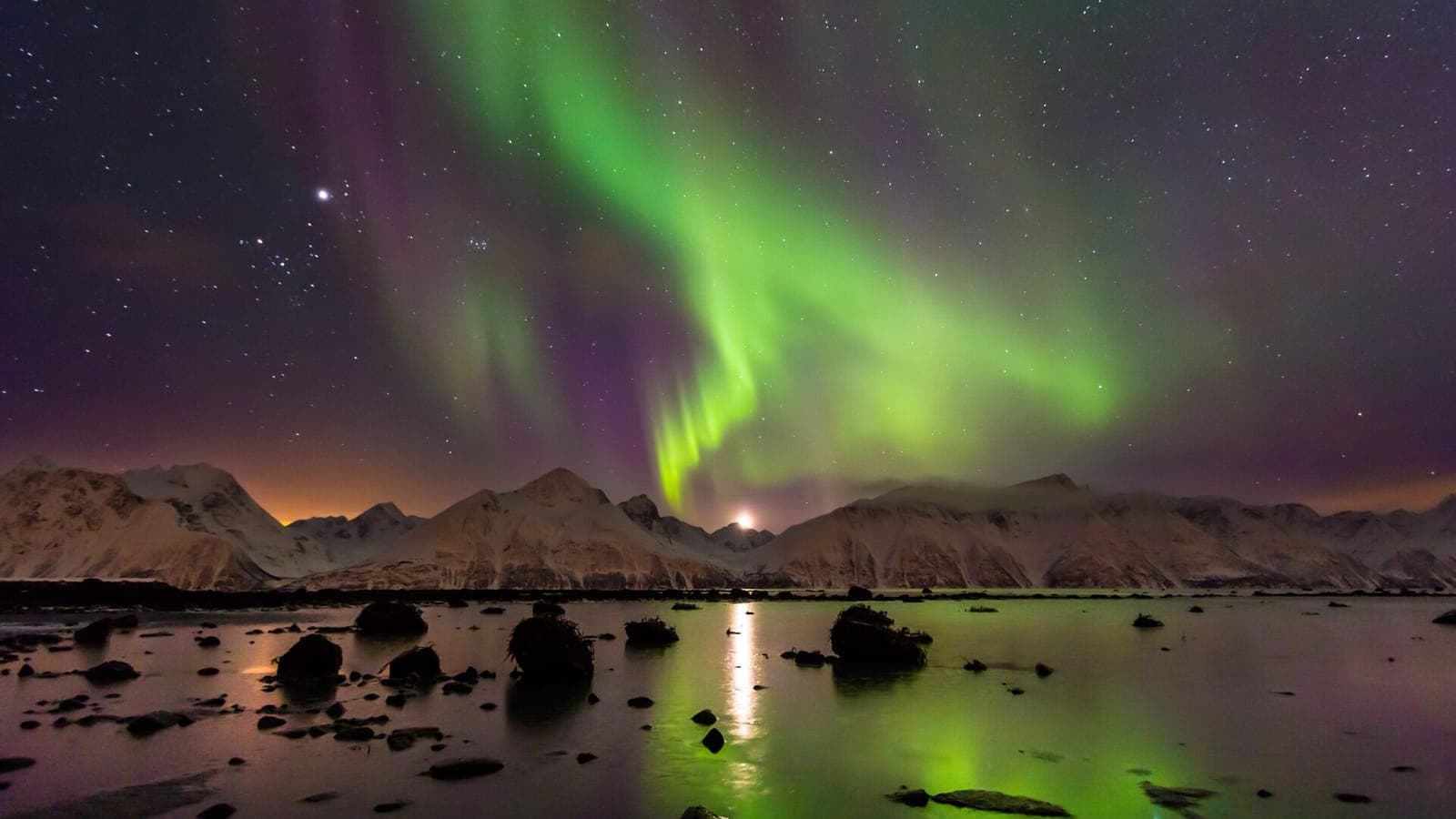
It's happening now: Earth's magnetic field is strongly disturbed, and NOAA SWPC is measuring Kp 5. If your sky is clear, go out and look north – the northern lights can come and go in waves all night.
| City | Chance | Clouds tonight |
|---|---|---|
| Kiruna | Good | Overcast |
| Umeå | Good | Overcast |
| Stockholm | Possible | Overcast |
| Gothenburg | Possible | Overcast |
| Malmö | Maybe on camera | Overcast |
Where can it be seen?
The best chances are in Kiruna and Umeå. There, the northern lights may climb high enough to be seen with the naked eye if the sky is dark and clear.
In Stockholm and Gothenburg, it may appear as a greenish glow or red pillars low in the sky towards the north.
In Malmö, it is most likely that only a phone camera in night mode will catch it. The camera gathers light for several seconds and sees colours the eye cannot.
Kp is a global three-hour average. The northern lights come in waves, and an outburst can last ten minutes or two hours, so patience pays off.
Tonight's clouds
Thick cloud is expected over Stockholm, Kiruna, Umeå, Gothenburg and Malmö for most of the night, so the chances there are slim. Cloud cover is Skycastor's forecast for the dark hours. It is updated continuously, so check again closer to the time.
How to get the best view
Find a dark spot with an open view to the north. Street lights and the glow of towns swallow the faint colours, and just twenty minutes out of town makes a big difference.
It is dark enough from about 19:14 until 05:54.
Good dark places include Abisko, Höga Kusten and Öland.
Give your eyes 15–20 minutes to adjust to the dark, and avoid looking at your phone screen in the meantime.
Try your phone's night mode, or a camera on a tripod with a 5–15 second exposure. The picture often shows stronger colours than the eye can see.
What is happening on the Sun?
Auroras form when electrically charged particles from the Sun hit Earth's magnetic field and are channelled down into the atmosphere around the poles. At 100–300 kilometres up, they collide with oxygen and nitrogen, which light up – oxygen in green and red, nitrogen in blue and violet.
That corresponds to a minor geomagnetic storm, G1 on NOAA's scale from 1 to 5.
The Kp index runs from 0 to 9 and shows how disturbed Earth's magnetic field is. At Kp 3, the northern lights are usually seen only in northern Norway, Lapland and Iceland. From Kp 5 they can reach Denmark, Scotland and northern Germany, and at Kp 8–9 they have been seen as far south as southern Europe.
Space weather is hard to forecast precisely, and the outlook can change at a few hours' notice. We update this article whenever NOAA updates its forecast.