
 Croatia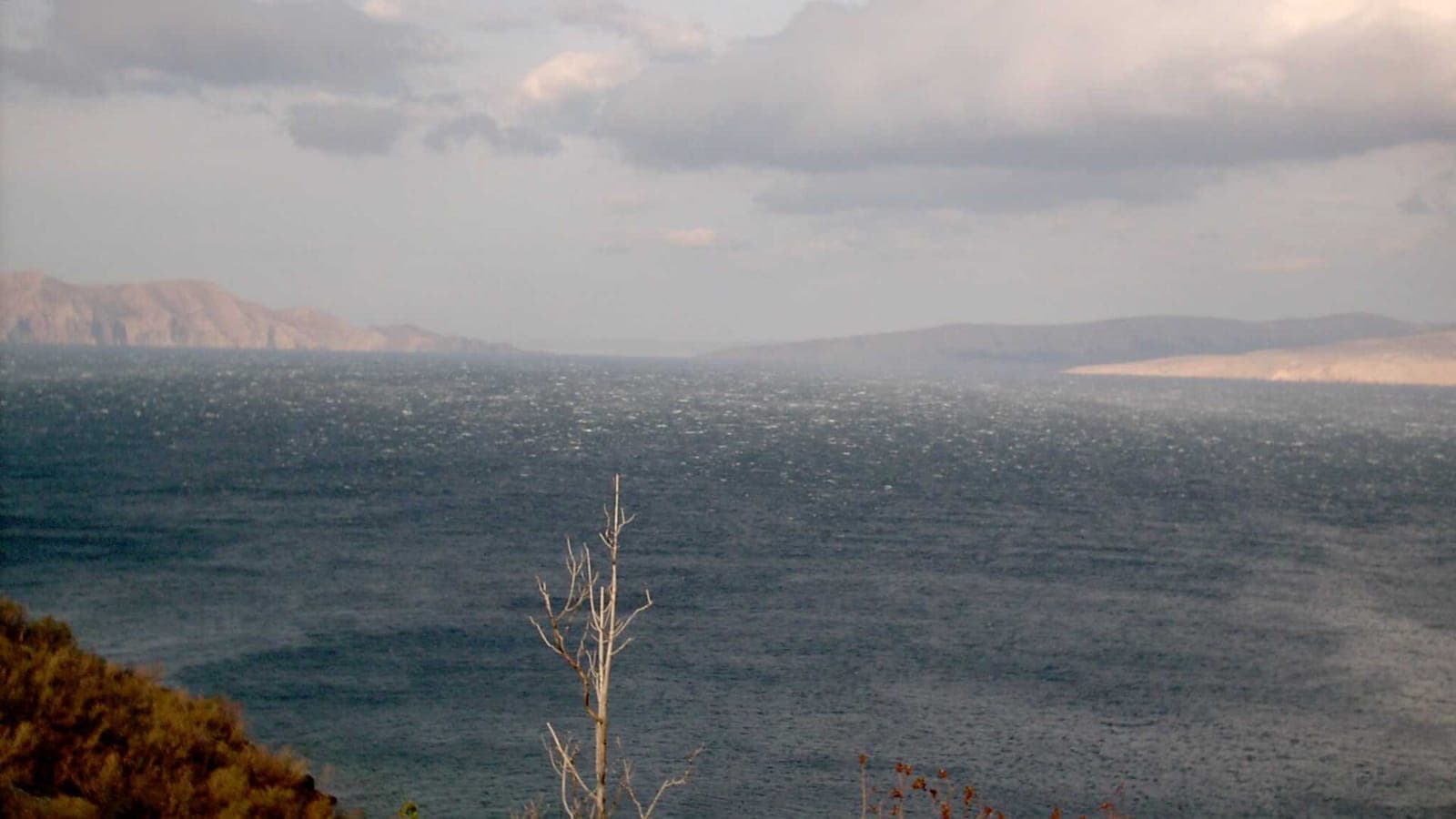
Along the northern Croatian coast, the most dramatic weather often arrives under a perfectly blue sky. The bura, a cold north-easterly wind, does not so much blow as fall: it tumbles down the mountains onto the Adriatic in violent gusts. For centuries it has shaped how people here build, sail and farm.
Air that pours over a wall
The bura is born on the inland side of the Dinaric Alps. In winter, cold, dense air collects over continental Croatia and the Pannonian lowlands, held back by a chain of mountains that runs parallel to the coast. When pressure is high inland and lower over the Adriatic, that cold air begins to spill through the passes and over the ridges. Like water pouring over a dam, it accelerates as it drops down the steep seaward slopes and reaches the shore with far more force than it had on the plateau above.
Because the air warms only a little on its short, steep descent, it arrives cold and very dry. That is why a bura day is often crisp and brilliantly clear, with visibility stretching to islands far out to sea. Meteorologists distinguish two main types. The anticyclonic bura, often called the clear bura, blows under blue skies. The cyclonic bura, known locally as ‘škura bura’, the dark bura, comes with a low-pressure system over the Adriatic and brings cloud, rain and sometimes snow.
Senj, the Velebit and the gusts
The bura is not equally strong everywhere. It is fiercest where the mountains are high and close to the sea, and where passes funnel the flow. The town of Senj, below the Vratnik pass, has long been known as the bura capital of the Adriatic. Further south, the Velebit, Croatia's longest mountain range at roughly 145 kilometres, rises almost straight out of the sea, and the channel beneath it is one of the windiest stretches of water in Europe.
What makes the bura so dangerous is not its average speed but its gusts. The wind arrives in pulses, called ‘refuli’ by locals, that rise and fall within seconds. Gusts of more than 200 kilometres per hour have been measured along the Velebit coast, strong enough to overturn lorries and caravans. Before a strong bura, a bank of white cloud often settles on the crest of the Velebit, the so-called cap, which coastal people have long read as a sign that the wind is about to strike.
Bridges, roads and ferries
Modern infrastructure has had to learn to live with the bura. The Krk Bridge, opened in 1980 to link the island of Krk with the mainland, was at the time a record-breaking concrete arch, and it stands squarely in the path of the wind. During strong bura it is closed to high-sided vehicles and at times to all traffic. Stretches of the A1 motorway near the Velebit, including the Maslenica crossing, face similar restrictions, and drivers on the coast road learn to check the wind before setting out.
At sea the disruption is just as real. Ferries and catamarans between the mainland and the islands of the Kvarner Gulf and northern Dalmatia are regularly cancelled when the bura rises, sometimes leaving islanders cut off for a day or more. Sailors treat the wind with deep respect: under bura the Adriatic turns into a field of short, steep waves, and sudden gusts can knock a yacht flat even in a sheltered bay. Nautical guides to the region devote whole chapters to it.
Islands salted white
Perhaps the most visible trace of the bura is the landscape itself. When the wind tears across the sea, it rips spray off the waves and carries fine droplets of salt water far onto the land, a phenomenon Croatians call ‘posolica’. Over centuries this salting has helped strip vegetation from the island slopes that face the Velebit. The island of Pag is the famous example: its bare, pale, almost lunar side looks towards the mainland, while its more sheltered side is noticeably greener.
People adapted in kind. Traditional houses in the bura zone are low and solid, with few openings on the windward side, and dry-stone walls criss-cross the islands, sheltering fields and flocks. Pag's sheep graze on sparse herbs dusted with salt, and islanders credit that pasture for the distinctive taste of the local cheese. The bura has its uses too: Dalmatian pršut, the region's air-cured ham, is traditionally dried in the cold, dry wind of winter.
Visit the Kvarner coast in winter and you may well meet the bura on a day of astonishing clarity, when the islands seem close enough to touch and the sea is streaked with white. Watch for the cloud cap on the Velebit, the wind warnings at the bridge and the cancelled ferries. And ask locals to compare it with the damp southern jugo: most will tell you the bura is the wind that clears your head.


 Japan
Japan
 Poland