
 Czechia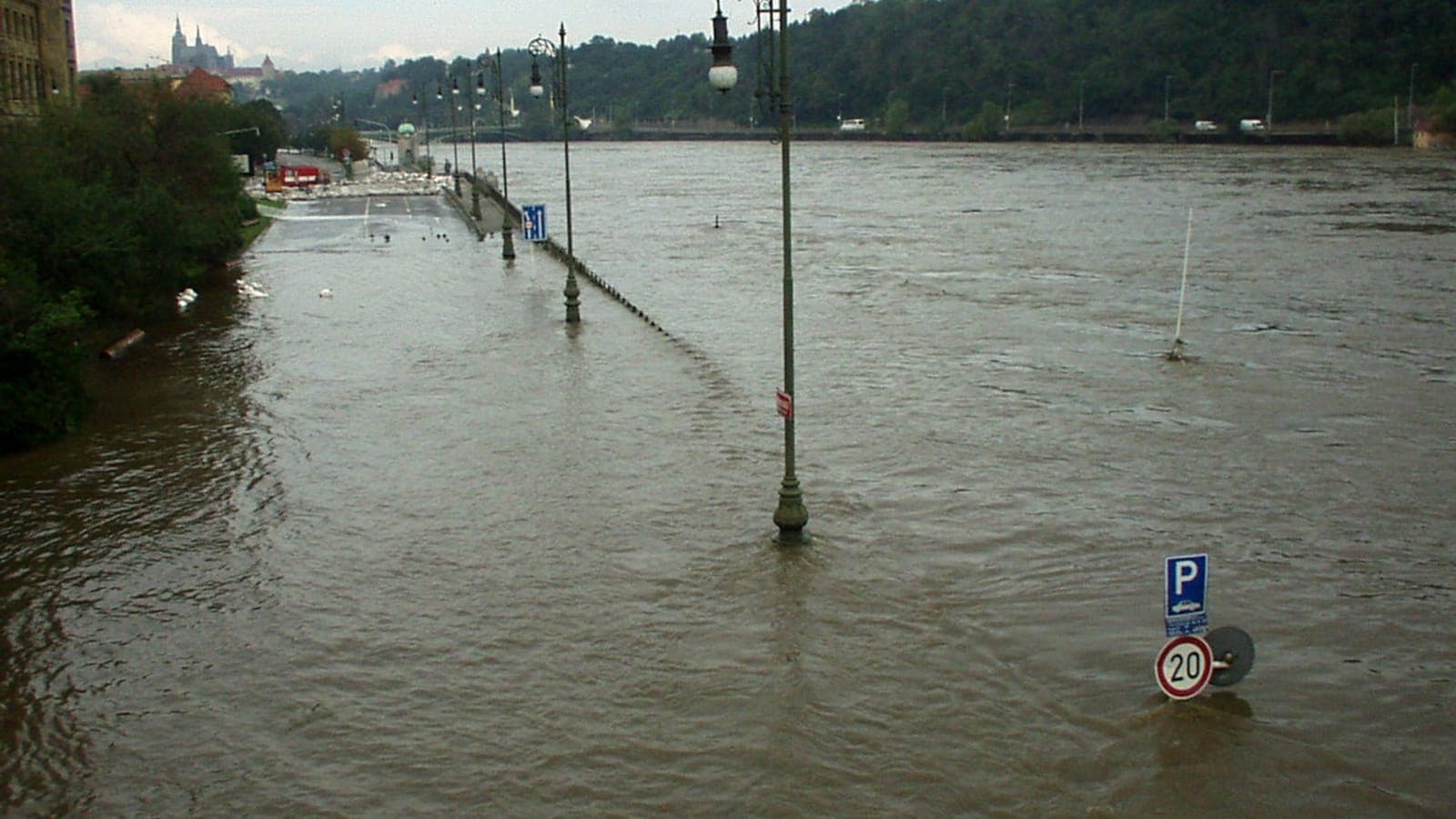
The Vltava is Prague's quiet companion, a river of swans, embankment cafés and slow paddle boats. In the second week of August 2002 it became something else. The flood that followed was the worst in the city's recorded history, and it changed how Prague protects its old heart.
Two lows, one week apart
The trouble came in two parts. On 6 and 7 August 2002 a low-pressure system from the Mediterranean, moving on the Vb track that hauls warm, saturated air around the Alps, dumped extreme rain on southern Bohemia. Rivers in the Šumava foothills and around České Budějovice rose sharply and then began to fall. Then, just as the ground was at its wettest, a second and much larger low arrived on 11 August and rained over almost the whole Czech basin for three days.
The Vltava has a chain of dams above Prague, the Vltava Cascade, with Lipno, Orlík and Slapy among them, and they had been designed to smooth out ordinary floods. This time the reservoirs, already full from the first storm, simply filled to the brim. Orlík rose above its intended maximum and water poured over the spillways. Tributaries such as the Berounka, the Sázava and the Lužnice were in full flood at the same moment. Everything converged on the capital.
The river takes the capital
By 12 August the Vltava was rising through the night. Volunteers and soldiers assembled the city's mobile flood walls around the Old Town, a system that had only partly been built. On the left bank the barriers at Malá Strana were incomplete, and the island quarter of Kampa disappeared beneath brown water. Across the river the low-lying district of Karlín flooded so deeply that whole streets were later declared unsafe. Metro tunnels, thought to be watertight, filled up, and more than a dozen stations were put out of service.
The peak came in the early hours of 14 August. The discharge at Prague reached roughly 5,000 cubic metres per second, around thirty times the river's usual August flow, and hydrologists later classed it as a flood expected less than once in five hundred years. Charles Bridge, which had lost three arches in the flood of 1890, held. Crowds stood on the embankments watching debris race under its arches, a scene the city had not seen in living memory.
A sea lion, a zoo and the road north
Prague Zoo lies in Troja, on the floodplain in the north of the city. As the water rose, keepers worked through the night to move animals uphill, but more than a hundred did not survive, including an elephant that could not be evacuated. The most famous escapee was Gaston, a sea lion who slipped out of his flooded enclosure, swam down the Vltava into the Elbe and was caught days later in Germany, exhausted; he died on the way back to Prague. Czechs still remember him.
The flood did not stop at Prague. Downstream, the Vltava joins the Elbe at Mělník, and the swollen river drowned Terezín, Litoměřice and Ústí nad Labem before crossing into Germany, where Dresden recorded its highest water level in centuries on 17 August. Upstream, České Budějovice, Písek and other South Bohemian towns had already been hit by the first wave. In all, a large part of the country was affected in one way or another.
What Prague learned
The toll in the Czech Republic was 17 dead, more than 200,000 people evacuated and damage estimated at roughly 73 billion crowns, the costliest natural disaster in the country's modern history. The metro stayed partly closed for months. Karlín, once written off, was rebuilt street by street and is today one of Prague's most fashionable districts, a transformation that began with the mud of 2002.
The city finished what it had started: a system of aluminium flood walls, sunk into sockets along the embankments, that can be raised within hours to seal the historic centre and vulnerable districts. It was tested in June 2013, when the Vltava rose high once more, and the barriers held. The Vltava Cascade is now operated with far more caution before forecast heavy rain, and flood warnings are among the most trusted forecasts in the country.
Walk the Vltava embankments today and look for the rows of metal sockets in the pavement: they hold the flood walls. On the Old Town side, near Charles Bridge, a carved stone head called Bradáč has served as a flood gauge for centuries; the saying goes that when the water reaches his beard, it is time to leave. In 2002 it went well past.

 United Kingdom
 Iceland