
 Iceland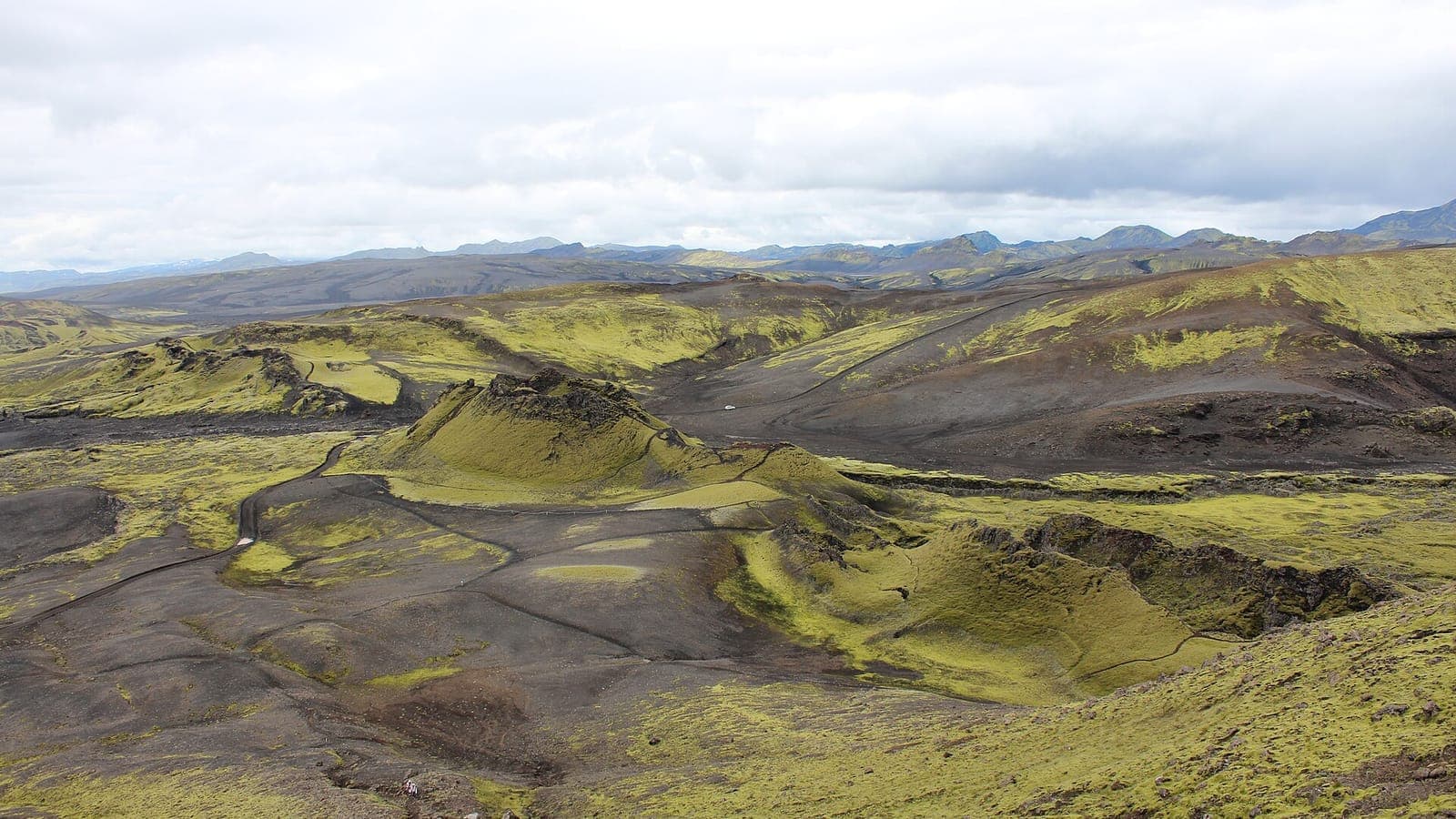
Iceland sits where the fire of the Mid-Atlantic Ridge meets the cold of the Arctic, and its weather has never been a purely local matter. In June 1783 that link became brutally clear. The Laki fissure began an eruption that would poison Iceland's grass, starve its people, and hang a strange dry haze over much of Europe.
Eight months of fire
On 8 June 1783, after days of earthquakes, the ground south-west of the Vatnajökull ice cap split open along a line that would grow to roughly 27 kilometres. Some 130 craters, today called Lakagígar, threw up fountains of lava and ash. This was not an explosive volcano like Vesuvius but a fissure eruption: enormous volumes of basalt flowing out over the plain, filling river gorges and creeping towards farms. By the time it ended in February 1784 it had produced one of the largest lava flows in recorded history, covering well over 500 square kilometres.
The most vivid record comes from Jón Steingrímsson, the pastor at Kirkjubæjarklaustur, who kept a diary as the lava advanced on his parish. On 20 July 1783 he held a service while the flow approached the church; the lava stopped short, and the event has been remembered ever since as the Fire Sermon. His account describes ash, sand, sulphurous rain and a sky that stayed dim for weeks. It remains one of the most important eyewitness descriptions of any eruption anywhere.
The mist hardships
Lava was not the worst of it. Laki released colossal amounts of sulphur dioxide and fluorine into the air, and the gases settled as a bluish haze over the whole island. Fluoride poisoned the grass; sheep and cattle sickened and died with deformed bones and teeth. Within a year more than half of Iceland's livestock was gone. With the animals went the milk, meat and wool that a subsistence society depended on, and the fishing was disrupted too, because the haze and the ash made the sea harder to work.
Icelanders call the years that followed Móðuharðindin, the Mist Hardships. Famine and disease killed roughly a fifth of the population, which was then only around fifty thousand people. The Danish crown, which ruled Iceland, is said to have discussed moving the survivors to Denmark, though nothing came of it. For a country that already lived on the edge of what a cold climate allowed, the eruption was the single worst catastrophe in its recorded history, and it is still spoken of that way.
A dry fog over Europe
Within weeks the sulphur cloud had drifted across the North Atlantic. From late June 1783 a strange dry fog lay over Britain, France, the Low Countries and central Europe. The sun rose and set blood-red, and at midday it could be looked at with the naked eye. In Selborne, the naturalist Gilbert White noted the smoky haze that clung to the countryside all summer. It coincided with unusual heat and violent thunderstorms, and in England the death rate rose sharply that summer and again the following winter.
The winter of 1783–84 was one of the coldest in living memory across Europe and eastern North America. In 1784 Benjamin Franklin, then living near Paris, wrote that the persistent fog might have come from an Icelandic volcano and might explain the severe cold. He was essentially right: sulphate particles high in the atmosphere reflect sunlight and cool the ground beneath. Laki is now one of the classic examples of how a single eruption can disturb the weather of an entire hemisphere.
If you don't like the weather, wait five minutes
Volcanoes aside, Iceland's ordinary weather is remarkable enough. The island lies at around 64 degrees north, yet Reykjavík's winters are about as mild as those of New York, thanks to the warm Irminger Current that branches off the North Atlantic Drift. That warm water meets cold polar air, and the result is the Icelandic Low, a near-permanent region of low pressure that steers one depression after another across the country, especially in winter. Wind, not cold, is the real hazard here.
This is why Icelanders joke that if you don't like the weather, you should wait five minutes. Sun, sleet, rain and gale can follow one another in a single afternoon. The south coast is far wetter than the north, and the great glaciers make weather of their own. Temperatures rarely drop far below freezing on the coast, but the wind can turn a mild day bitter and can push cars off exposed roads. Checking the forecast before leaving the house is simply part of daily life.
Today the Lakagígar craters are a quiet chain of moss-covered cones in the highlands, reachable only in summer. Yet the link they revealed still holds: what Iceland's volcanoes put into the air can shape weather far away. And on any ordinary day, the island's own restless skies remind every visitor that here, five minutes can change everything.

 Norway
 Thailand