
 Egypt
Egypt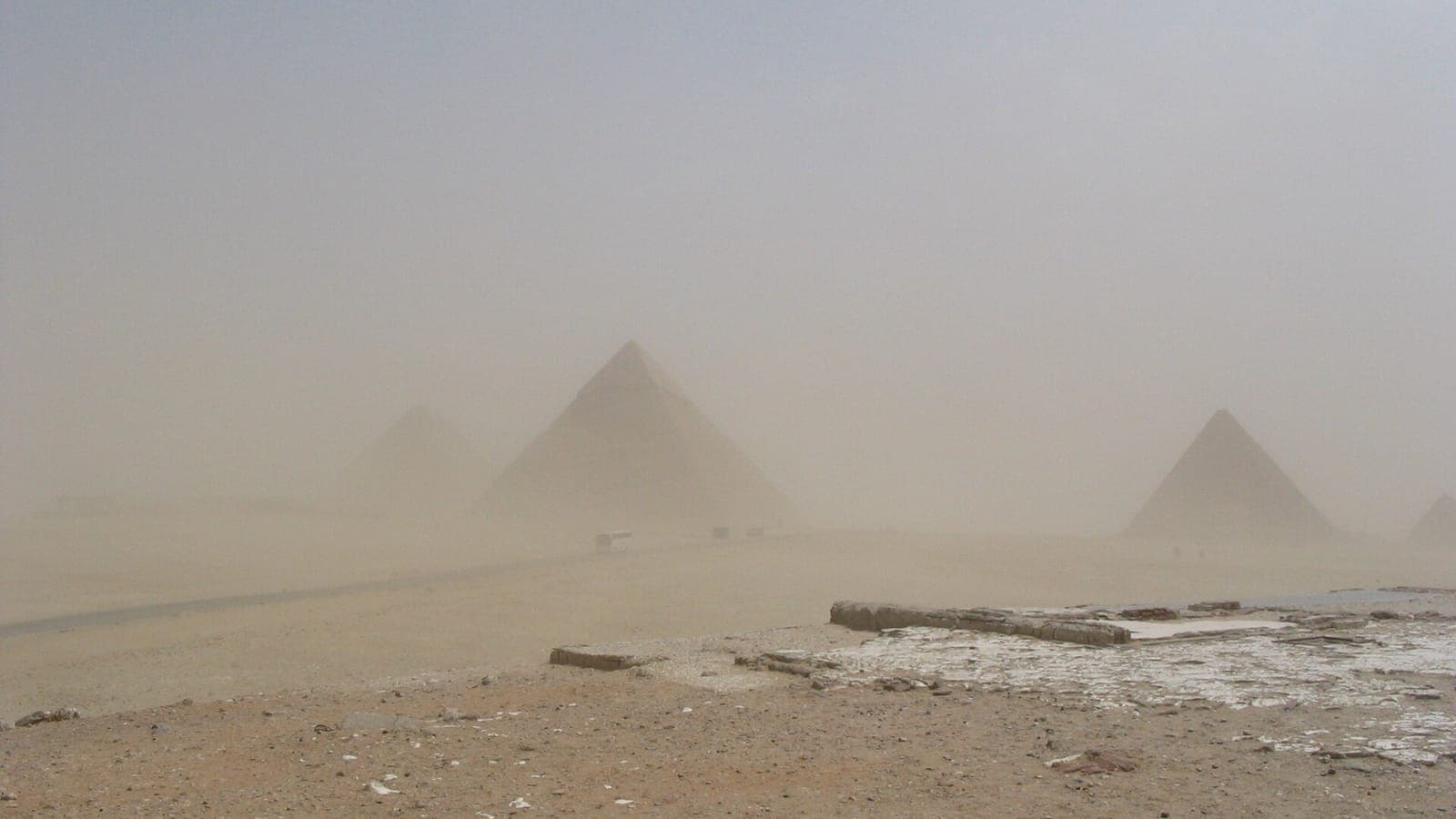
Egypt is one of the driest countries on Earth, and for most of the year its weather is a study in stillness: blue sky, dry air, the Nile gliding past. Then spring arrives, and with it the khamsin. For a few days at a time, the desert comes to town.
Why fifty?
The word khamsin is Arabic for fifty. Egyptians have long said the wind blows across a fifty-day stretch of spring, roughly from March into May, when winter has loosened its grip but the summer heat has not yet settled. The number is not a meteorological measurement but a folk calendar: the season was traditionally counted from around Coptic Easter, and the spring festival of Sham el-Nessim, celebrated the day after it, falls squarely inside khamsin time. The idea of a fifty-day windy season is far older than modern forecasting.
The wind does not blow for fifty days without pause. It comes in episodes, each lasting from a few hours to two or three days, with calm and often pleasant weather in between. A typical spring brings several such episodes, some mild, some fierce. What unites them is the direction and the feel: air arriving from the south or south-east, out of the Sahara, hot and bone-dry, carrying sand and fine dust. Along the Nile valley people know the signs: a yellowing sky, a sudden hush, then the heat.
Where the wind is born
The khamsin is the child of low-pressure systems that form over the northern Sahara in spring and track eastward along the North African coast towards the eastern Mediterranean. Ahead of each low, the wind swings round to the south and drags desert air northwards over Egypt. Behind it, a cold front sweeps through and the wind veers to the north-west, bringing cooler, moister air in from the sea. The whole sequence, heat then relief, can play out in a day or two, which is why the khamsin feels so abrupt.
The same family of storms has cousins all along the southern Mediterranean. In Libya the desert wind is the ghibli, in Italy and Malta the sirocco, in Israel the sharav. All are the same warm sector of a passing depression, dressed in local names. Spring is their season because that is when the Sahara heats up quickly while the Mediterranean is still cool, a contrast that feeds the lows. By June the pattern fades, the sea breeze takes over, and Egypt slips into its long, stable summer.
Heat, dust and the valley
When the khamsin arrives the numbers move fast. Temperatures can climb by more than ten degrees within a few hours, sometimes pushing Cairo above 40 °C in April, while humidity collapses to desert values. Visibility drops as dust fills the air; on bad days the sun becomes a pale disc and Cairo's airport has had to suspend flights. Farmers along the Nile dread it, because the hot, dry blast can scorch young crops, and anyone with a window learns to keep it shut and to wipe a film of grit off every surface afterwards.
The ancient Egyptians knew this wind well. Their world was divided between Kemet, the black fertile land of the Nile flood, and Deshret, the red land of the desert. The desert belonged to the god Set, lord of storms, sand and disorder, and the hot wind that blew from his domain was part of that chaos. The contrast still defines the country: almost all of Egypt's people live along the narrow green strip of the Nile valley and its delta, and the khamsin is the desert reminding them how close it is.
Armies, travellers and a dry land
Foreign visitors have always written about the khamsin with a shudder. Napoleon's soldiers, campaigning in Egypt from 1798, complained of the burning wind and blinding dust, and in the Second World War the armies fighting across the Western Desert learned to halt operations when a sandstorm blew up, with tanks, aircraft and men blinded alike. Nineteenth-century travellers on the Nile described the sky turning the colour of copper and the air tasting of sand. None of them found it easy to describe; all agreed it was unforgettable.
Part of what makes the khamsin so striking is the calm that surrounds it. Cairo receives only around 25 millimetres of rain in an average year, and Aswan in the south can go years without a measurable drop. Egypt's water comes not from its sky but from its river, fed by rains that fall far away in Ethiopia and the African highlands. In a climate with so little weather, a few days of roaring desert wind are the closest thing to drama, and they arrive right on schedule each spring.
Visit Egypt in spring and you may catch it: a morning that starts clear, a sky that slowly turns ochre, a hot wind that makes the palms hiss and empties the streets. Locals shrug, close the shutters and wait. A day later the air is fresh again, and the Nile looks as calm as ever.

 Hungary
 South Korea