
 Hungary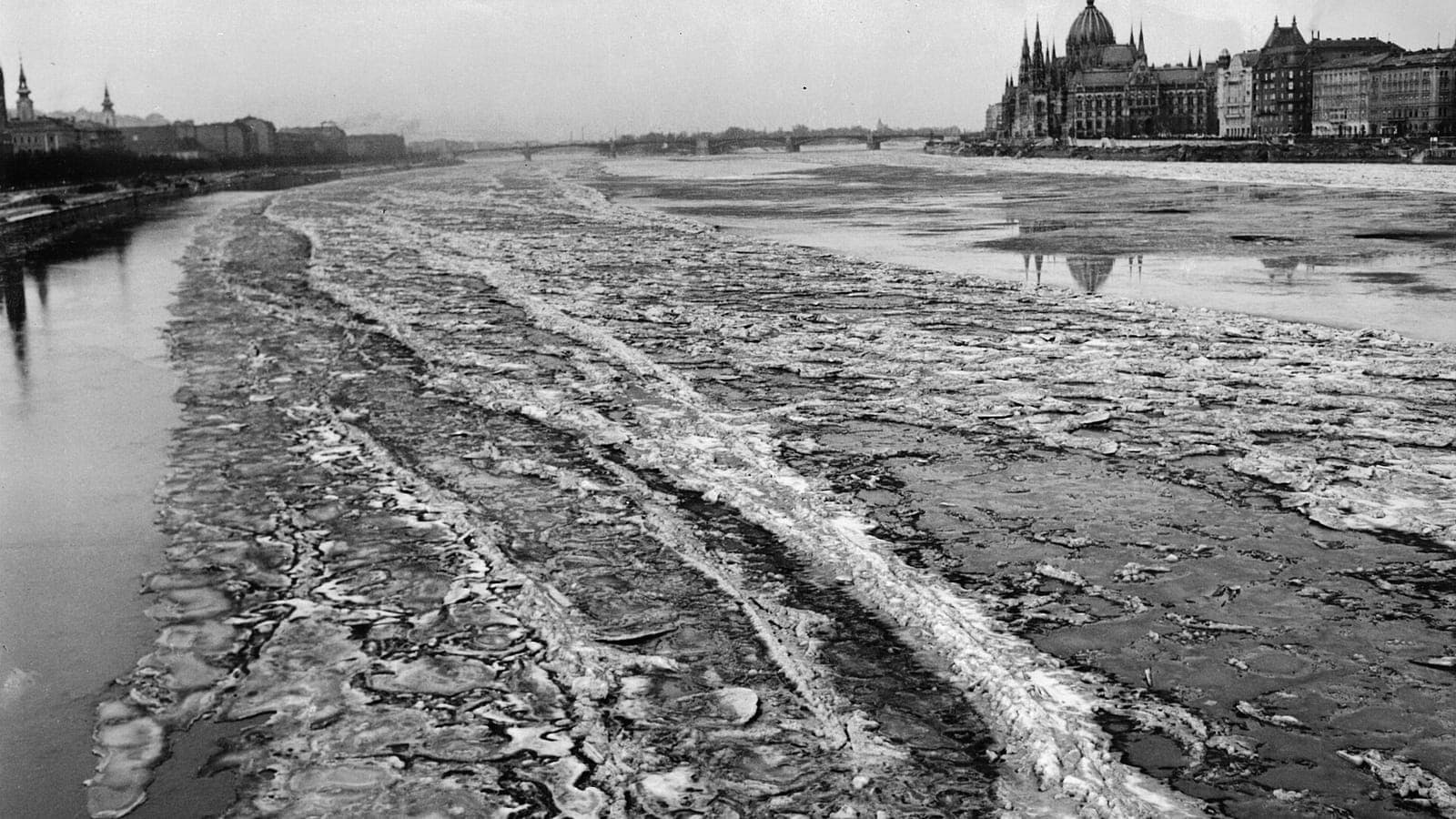
Rivers usually flood when it rains too much. The Danube in 1838 flooded because it had frozen too hard. When a bitter winter finally broke, the ice did not melt away quietly: it piled up into a dam, the water behind it rose, and on the night of 13 March it burst into the streets of Pest. Within days most of the town lay in ruins.
A winter that would not let go
The winter of 1837–38 was one of the harshest the Hungarian plain had seen in living memory. Weeks of hard frost turned the Danube into a solid road of ice that people crossed on foot between Buda and Pest. The river was then still a wild, braided stream, full of shoals and side channels, without the straight regulated bed and stone quays we know today. That mattered, because when ice starts to move, it needs a clear path to escape downstream.
In early March the thaw finally came, and it came fast. Warm winds and rain loosened the ice upstream, and huge floes began drifting down towards the capital. South of Pest, around the northern tip of Csepel Island, the river was shallow and split into arms. The floes jammed there, one on top of another, until they formed a dam of ice many kilometres long. Behind it, the Danube had nowhere to go but up, and out.
The night of 13 March
For days the water had been rising steadily along the low riverbank of Pest, and the town's earth dykes were holding. Then, on the evening of 13 March, they gave way. Water rushed through the streets of the lower districts, Ferencváros, Józsefváros and Lipótváros, faster than people could carry their belongings upstairs. In the dark, the only light came from lanterns on boats and from the windows of houses that were still standing.
Most of Pest was built of sun-dried mud brick, cheap and quick to lay but useless once soaked. Walls softened and collapsed, sometimes with whole families inside. The water stayed high for about three days. When it finally drained away, roughly half of the town's buildings had fallen or were beyond repair, and around 150 people had died. Tens of thousands were homeless in what had been, weeks earlier, a lively, growing market town.
The boatman of the flood
Out of the disaster came a hero. Baron Miklós Wesselényi, a reform politician from Transylvania, spent the nights of the flood in a rowing boat, pulling people from windows and rooftops and ferrying them to dry ground. Contemporaries counted his rescues in the hundreds. He became known as "the boatman of the flood", and the poet Mihály Vörösmarty later celebrated him in verse. His courage turned a private tragedy into a national story.
The city still remembers him. On the wall of the Franciscan church at Ferenciek tere, a bronze relief shows Wesselényi standing in his boat, and beside it a small plaque marks how high the water reached. Similar flood marks survive on older buildings across the inner city and Óbuda. Look for them at roughly head height or higher, and you understand at once why the town that rose afterwards was built so differently.
What the flood built
The rebuilding of Pest after 1838 was one of the turning points in the making of modern Budapest. New rules required stone or fired brick instead of mud, streets were laid out wider and straighter, and the riverbank was gradually raised and armoured with the stone embankments that still line the Danube. Over the following decades the river itself was regulated, its shoals dredged and side arms closed, so that ice could pass more easily.
Ice floods did not vanish. In March 1956 an ice jam on the lower Hungarian Danube broke dykes and flooded villages near Mohács, and each winter icebreaker ships still stand ready on the river. But the capital has never again seen the water climb as it did in 1838. Even the great flood of June 2013, the highest measured at Budapest in modern times, was held back by the embankments the disaster taught the city to build.
Stand on the Pest embankment on a cold February morning and you may see the Danube carrying plates of ice past the Parliament. It looks harmless, almost decorative. The quays under your feet, the wide boulevards behind you and the flood marks on the old churches are all reminders that once, the ice was the most dangerous weather this city knew.


 South Korea
 Portugal