
 Finland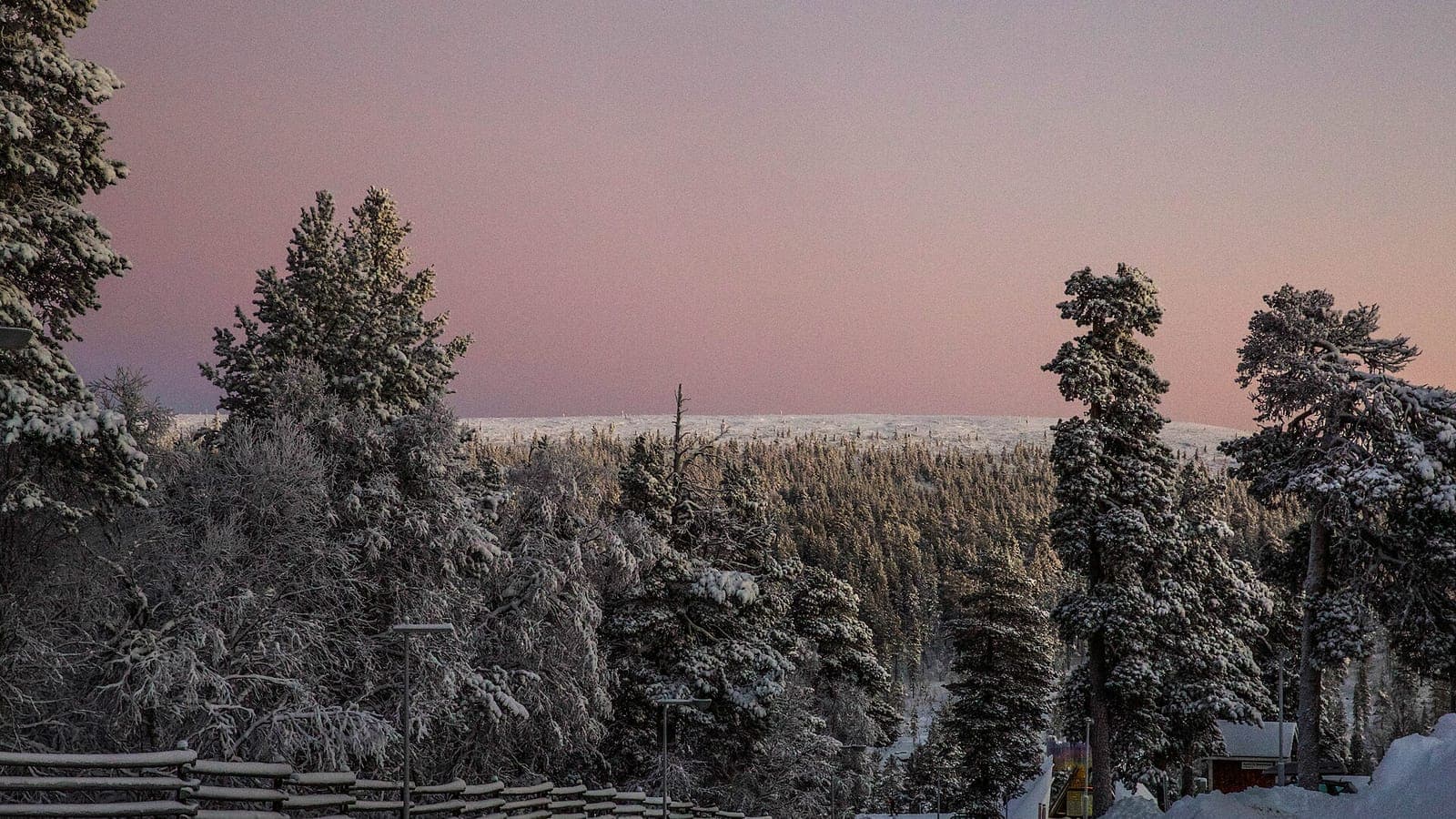
Above the Arctic Circle, Finland spends part of every winter without a sunrise. The Finns call this season kaamos, and it shapes everything from the colour of the sky to the rhythm of daily life. Behind it lies one of Europe's most continental winter climates – one that once turned into a national catastrophe.
When the sun stays below the horizon
Kaamos is the Finnish name for the polar night: the period when the sun does not climb above the horizon at all. It happens because the Earth's axis is tilted, so in midwinter the far north is turned away from the sun. On the Arctic Circle itself, which runs just north of Rovaniemi, the effect is marginal – around the winter solstice the sun barely peeps over the horizon, or merely grazes it.
The farther north you travel, the longer the sunless stretch becomes. In Utsjoki, Finland's northernmost municipality on the border with Norway, the sun stays hidden for roughly seven weeks, from late November until the middle of January. In summer the same places get the reverse: the midnight sun, which Finns call yötön yö, the nightless night. Few places show the tilt of our planet as plainly as Lapland.
Not darkness, but blue
Visitors who expect pitch-black days are usually surprised. Even when the sun stays below the horizon, it is only just below, so for several hours around midday the sky fills with a long twilight. The light turns deep blue and violet, sometimes with pink bands low in the south. Snow on the ground and on the trees reflects every trace of it, so the landscape often seems brighter than the sky above.
When the twilight fades, the long nights open the stage for the northern lights. Finnish Lapland lies beneath the auroral oval, and on clear, cold nights green curtains, sometimes edged with pink or violet, can ripple across the sky for hours. The Finnish word is revontulet, literally 'fox fires', from an old story of a fox whose tail swept the snow and threw sparks into the heavens.
A continental winter
Finland sits between the mild Atlantic to the west and the vast Eurasian landmass to the east, and in winter the east often wins. When high pressure settles over Scandinavia and Russia, skies clear, the snow radiates its heat away and temperatures plunge. The coldest reading ever recorded in Finland, −51.5 °C, was measured at Pokka in Kittilä, Lapland, on 28 January 1999.
The cold is strong enough to freeze the sea. The northern Gulf of Bothnia is covered by ice every winter, and in severe years ice spreads across much of the Baltic, so Finland relies on a fleet of icebreakers to keep its ports open. Yet the country is still far milder than its latitude suggests: thanks to air warmed by the Atlantic, Lapland is much less harsh than places at the same latitude in Siberia or Canada.
1867: the year winter would not let go
Finland's climate can also be cruel. The famine of 1866–1868, remembered as the great hunger years, peaked after the spring of 1867 failed to arrive. Snow and ice lingered deep into late spring, lakes stayed frozen far longer than normal and sowing came weeks late. Then, before the crops could ripen, early frosts in the autumn destroyed much of what little had grown.
The harvest failed across much of the country, which was then a Grand Duchy under the Russian Empire. People mixed ground pine bark into their bread, known as pettuleipä, and many left home to beg along the roads, spreading disease. It was one of the last great peacetime famines in Europe. The disaster pushed Finland to improve its food supply, relief work and transport – lessons shaped directly by the weather.
Today the kaamos is something Finns plan for rather than fear. Homes glow with candles and saunas, streets are lit early, and travellers come to Lapland precisely for the blue midday light and the chance of northern lights. Stand in a snowy forest at noon in December and you will see it yourself: a day that never quite begins, yet is never truly dark.

 Ireland
 Mexico