
 France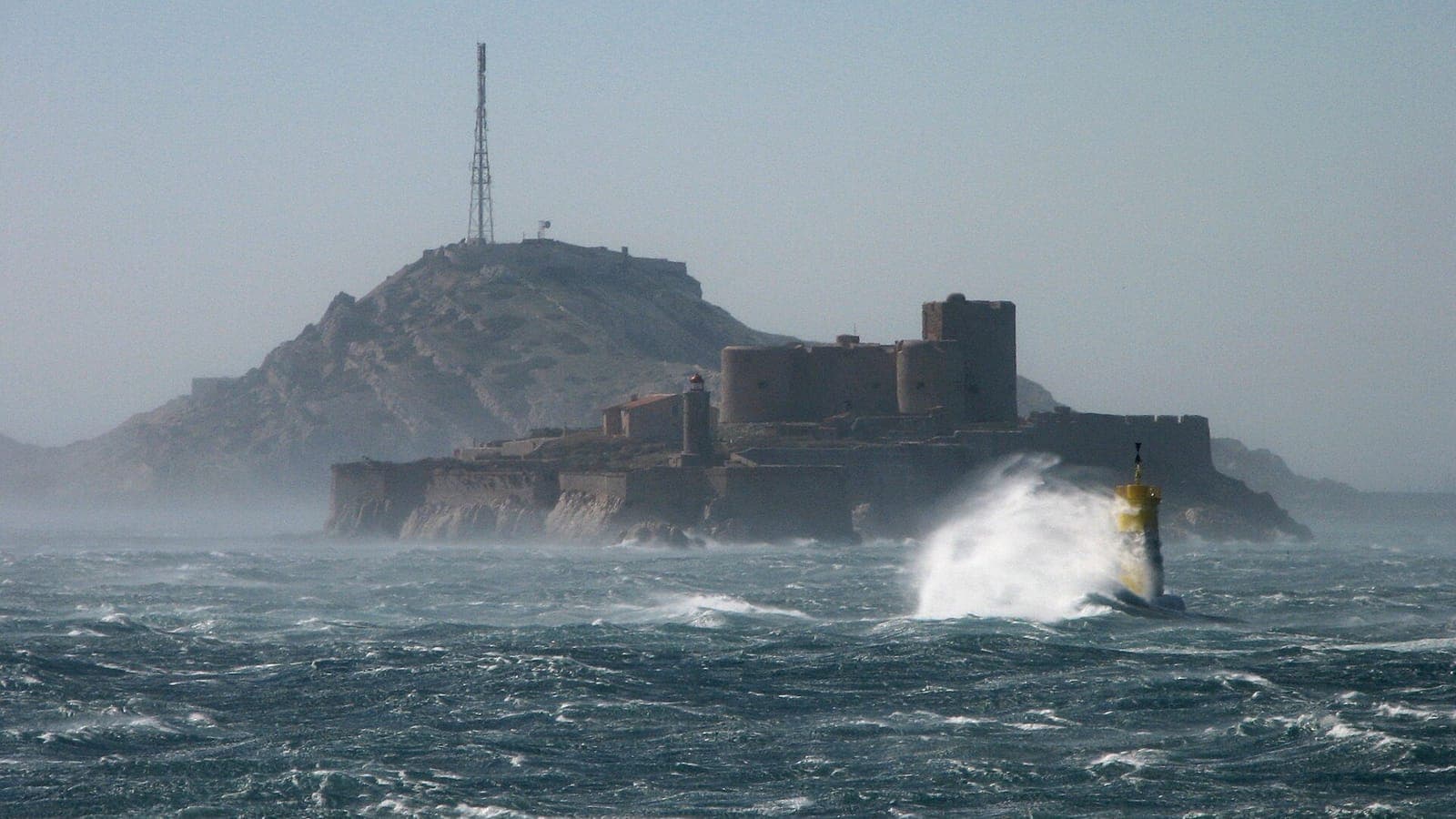
The mistral is a cold, dry wind that races down the Rhône valley and out over the Mediterranean. It can blow for days, bend trees permanently and drive people indoors, yet it is also the reason Provence has the sharp light and deep blue skies that painters have chased for more than a century.
Where the wind is born
The mistral begins with a particular pressure pattern: high pressure over the Bay of Biscay or the Atlantic side of France, and low pressure over the Gulf of Genoa in the northwestern Mediterranean. Air flows from high to low, which means from northwest to southeast across France. On its way it meets the two great mountain blocks of the south, the Massif Central to the west and the Alps to the east. Between them lies the only open corridor to the sea: the Rhône valley. The air is funnelled into this narrowing channel and accelerates, much as water speeds up where a river narrows.
By the time it reaches the Rhône delta and the coast around Marseille, the wind has become the mistral proper: a dry, cold, north-to-northwesterly blast that can gust above 100 km/h. It fans out over the Gulf of Lion, where it whips up short, steep waves that sailors treat with respect. The wind is most frequent in winter and spring, but it can appear in any month. Its name comes from the Occitan word for "masterly", and anyone who has tried to walk against it in Avignon or Arles understands why.
Three days, six days, nine days
Provençal tradition says the mistral blows in multiples of three: three days, six days or nine. Meteorology does not really support the arithmetic, but it does explain the pattern behind it. The pressure systems that create the wind tend to be stable for several days at a time, so once it starts, the mistral rarely stops after a few hours. Locals learn to read the signs: a sudden drop in temperature, a sky scrubbed to a hard blue, and the sound of shutters banging. Then they settle in and wait.
The wind is famously strong in the Rhône valley towns and along the coast. As it fans out, it changes direction: northerly in the Rhône valley, it turns north-westerly around Marseille and westerly along the Var coast east of Toulon and over Corsica. Because the air has descended from the north and been squeezed through the valley, it arrives dry and clear. In January, with the wind adding its own chill, a mistral day can feel like deep winter even under a cloudless sky.
Cypress hedges and stone-weighted roofs
Centuries of living with the wind have shaped the landscape of Provence. Farmers planted long, dense rows of cypress trees along the northern edge of their fields as windbreaks, and these dark green walls are now as much a part of the scenery as lavender or olives. Traditional farmhouses, the mas, turn their backs to the north: blank, windowless walls face the wind, while doors and windows open to the south. On old roofs the tiles were held down with stones so that a strong gust could not lift them.
The mistral has its uses too. It dries the soil and the air, which keeps vines and fruit trees healthier by discouraging fungal disease, and growers in the Rhône valley have long counted it as an ally. It clears pollution and haze, so that after a mistral the Alps can seem startlingly close from the coast. The same dryness is dangerous in summer: when the wind arrives during a drought, it can turn a small fire in the garrigue into a fast-moving blaze within minutes, and firefighters watch the forecast closely.
The light the painters chased
Vincent van Gogh arrived in Arles in February 1888 and quickly discovered the wind. In letters to his brother Theo he complained that the mistral made painting outdoors nearly impossible; he pegged his easel down and kept going anyway. The wind's clean, brilliant light is in many of his Provence canvases, and some see its swirling force in his skies. Paul Cézanne, painting the Montagne Sainte-Victoire near Aix-en-Provence, worked in the same clear air, and the region's reputation among artists was sealed.
The word mistral also belongs to Frédéric Mistral, the Provençal poet who won the Nobel Prize in Literature in 1904 and spent his life defending the Occitan language. The coincidence delights locals: the wind and the poet share a name meaning "masterly", and both came to stand for Provence itself. Today the mistral appears in songs, on postcards and in the names of trains and cafés. A visitor who arrives on a windy day may curse it, but they are seeing the region exactly as the painters did.
On a mistral day the sky over Marseille turns a blue so deep it looks painted, the sea is flecked with white and the air smells of nothing at all. Residents hold on to their hats and joke that the wind blows madness into people. Visitors notice the cypress rows leaning south and the shuttered north walls, and understand that this landscape was built around a wind.

 India
India
 Netherlands