
 Germany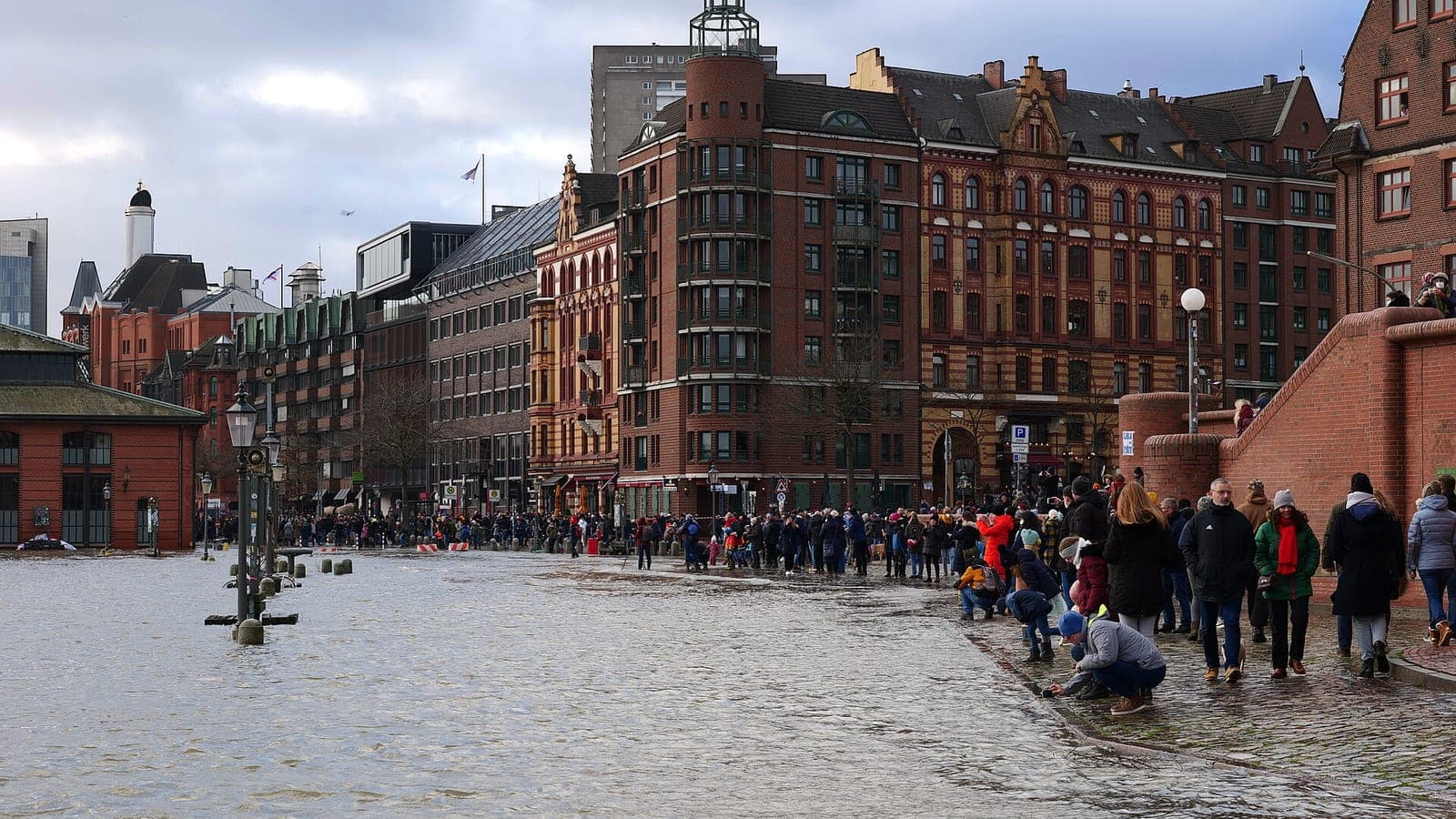
Hamburg is a port city, but not a coastal one: the North Sea is roughly 100 kilometres away, at the end of the long Elbe estuary. On the night of 16 to 17 February 1962, that distance offered no protection at all. A storm surge broke through the dikes, flooded about a sixth of the city and killed 315 people in Hamburg alone.
A storm called Vincinette
In mid-February 1962 a deep low-pressure system moved from the area around Iceland across Scandinavia. Meteorologists in Berlin, who at the time gave names to the lows crossing Europe, called it Vincinette. Behind it, strong north-westerly gales blew across the North Sea for many hours without a break. Winds from that direction are the most dangerous for the German coast, because they drive the water straight into the south-eastern corner of the North Sea, the German Bight, where the Elbe, the Weser and the Ems reach the sea.
Storm surge warnings were issued for the coast and for Hamburg. But it was a Friday night, many people were already asleep, and the danger for a city so far inland was badly underestimated. Few people in the low-lying districts expected the sea itself to arrive at their doors. When the water rose through the evening and into the night, telephone lines and electricity began to fail, and many residents never heard any warning at all.
Why a city far inland floods
The German Bight is shallow and shaped like a funnel. When a north-westerly storm pushes water into it for hours, the sea level at the coast rises far above the normal tide. The Elbe estuary then acts as a second funnel: the piled-up water is squeezed upstream, narrowing towards Hamburg, and a surge can even grow on its way inland. In 1962 the storm also lasted so long that the ebb tide barely lowered the water between two high tides.
At the St. Pauli gauge in the port, the water reached 5.70 metres above sea level, higher than anyone had measured there before. Many of Hamburg's dikes were old, too low and had steep inner slopes. Water spilling over the crest washed these slopes away from behind, and the dikes gave way in dozens of places. The breaches came in the dark, in the early hours of 17 February, often with little or no warning for those behind them.
Wilhelmsburg and a senator who took charge
The worst-hit area was Wilhelmsburg, a large, low island between two arms of the Elbe. After the bombing of the Second World War, thousands of people there still lived in simple huts and emergency homes in allotment gardens. These single-storey buildings offered no escape upwards, and the water rose within minutes. Most of the victims died in Wilhelmsburg. Across the city, tens of thousands of people were cut off, many of them waiting on rooftops in the cold February night.
The rescue became closely linked with Helmut Schmidt, then Hamburg's senator in charge of the police and later West German chancellor. He took command of the crisis and called in the Bundeswehr and allied NATO forces, even though the constitution at the time made no clear provision for using soldiers at home. Helicopters, boats and army vehicles plucked people from roofs and flooded streets. The episode made Schmidt nationally known as a decisive crisis manager.
Higher dikes, higher waters
After the disaster, Hamburg rebuilt its flood defences on a completely new scale. Dikes were raised and made much wider, with gentle slopes that could survive water spilling over them, and floodgates and flood walls closed the gaps along the port and the river. Other coastal states in northern Germany did the same. The warning system was also improved, so that storm surge forecasts reach both the authorities and residents in time.
The new defences were soon tested. In January 1976 another storm surge pushed the Elbe to about 6.45 metres at St. Pauli, clearly higher than in 1962. This time Hamburg's dikes held, and the city escaped without the kind of loss it had suffered fourteen years earlier. That level is still the highest ever recorded at St. Pauli, and the dikes continue to be raised as sea levels rise with a warming climate.
Storm surges are still a normal part of a Hamburg winter. Several times a season, the famous Fischmarkt in St. Pauli disappears under the Elbe, and locals know to move their cars before the water arrives. The new HafenCity district stands on raised ground for exactly this reason. In Wilhelmsburg, memorials and flood marks recall the night of 1962, when the sea proved it could reach far inland.

 Greece
 Italy
Italy