
 Greece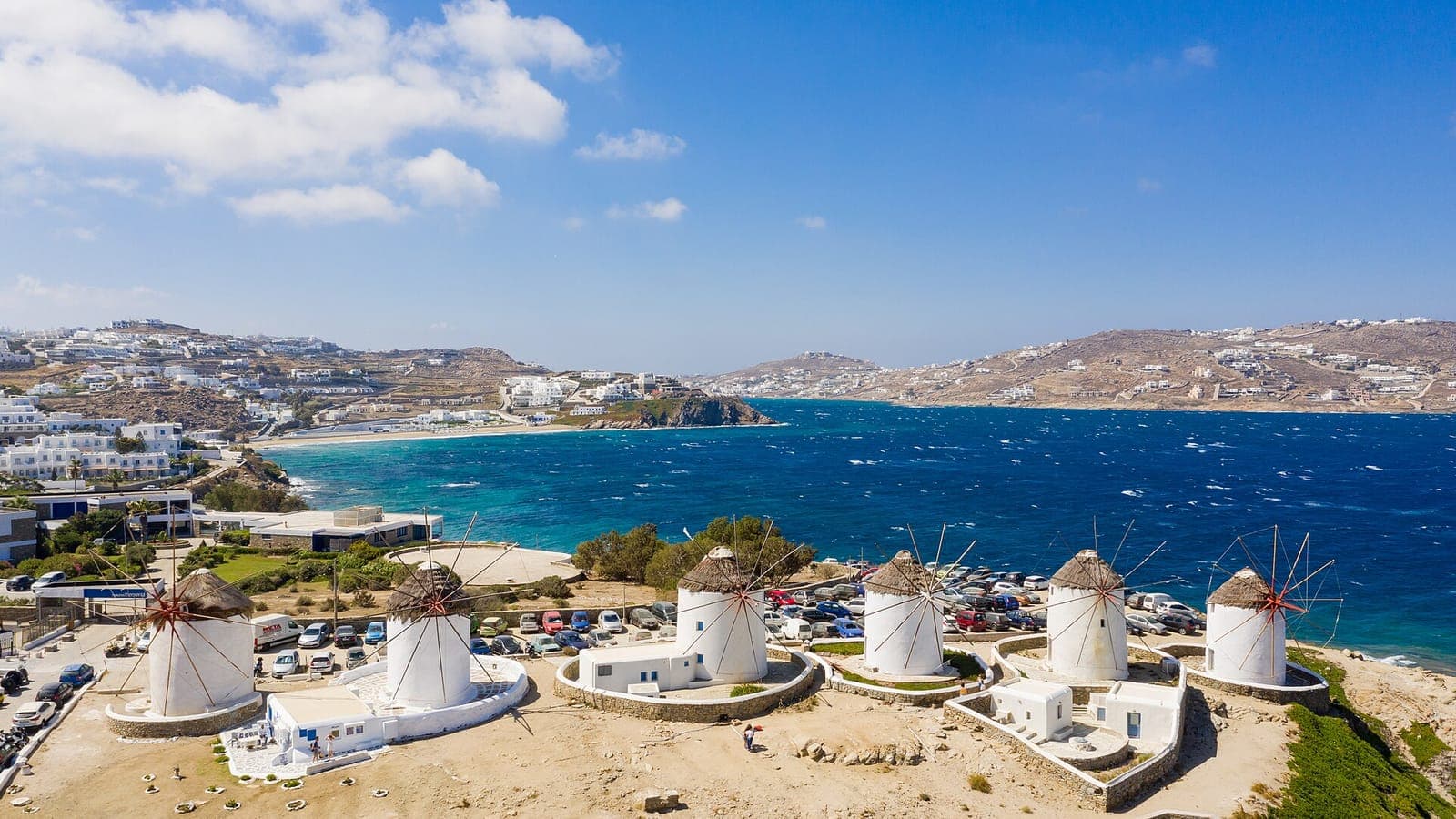
Ask anyone who has waited on a Cycladic quay for a cancelled ferry and they will tell you about the meltemi. From late spring to early autumn this steady north wind pours down the Aegean, whipping the sea white and scrubbing the sky a hard, cloudless blue. It is the single most important fact of the Greek summer, and it has been shaping life here for at least two and a half thousand years.
Where the wind comes from
The meltemi is born from a tug-of-war between two great pressure systems. In summer the Azores high stretches eastward across the Balkans, while intense heating over Anatolia and the Middle East creates a broad area of low pressure, a distant western outpost of the Asian monsoon low. Air flows from the high towards the low, and the Aegean lies right in the corridor between them. Squeezed between the mountains of mainland Greece and Turkey, the flow accelerates over the open water into a persistent north wind.
The wind changes character as it travels south. In the northern Aegean it arrives from the north or northeast; by the time it reaches the Cyclades it blows from due north; and around Crete, Karpathos and Rhodes it bends to the northwest. It is strongest in the afternoon, when heating over the islands adds to the pressure gradient, and often eases after sunset near the coasts. Typical strength is force 5 to 6 on the Beaufort scale, but force 7 or 8 is common in the central Aegean, and gusts can be stronger still.
The etesians of the ancients
The Greeks of antiquity called these winds the etesiai, the annual winds, from etos, the word for year, because they returned so faithfully each summer. Aristotle discussed them in his Meteorologica, and Herodotus recorded a theory, popular in his day, that the etesian winds caused the summer flooding of the Nile by holding back the river's outflow into the sea. Herodotus himself was unconvinced, but the debate shows how prominent the wind was in the Greek picture of the world.
Sailing in the ancient Aegean was organised around it. Heading north against the etesians in July was slow and dangerous, while the run south to Crete and Egypt could be fast. The modern name arrived much later: meltemi comes from the Turkish meltem, a word for a sea breeze, adopted during the Ottoman centuries and now used across Greece. Whichever name you use, the wind itself has not changed: the same pressure pattern that Aristotle observed still switches on each summer.
Windmills, white villages and windsurfers
Few landscapes are as clearly shaped by wind as the Cyclades. The famous windmills of Mykonos, the Kato Mili, were built to catch the meltemi and grind grain for passing ships, and mills once stood on Paros, Naxos, Ios and many other islands. The traditional villages themselves hint at the wind: low, thick-walled whitewashed houses huddled together on the slopes, with narrow, twisting lanes that break the force of the gusts and offer shelter within a few steps.
Today the meltemi draws a different crowd. Windsurfers and kitesurfers gather at Golden Beach on Paros, at Mikri Vigla on Naxos, at Prasonisi on the southern tip of Rhodes and in the bays of Karpathos, where the wind is strong enough to be world class through July and August. Yachtsmen treat it with more respect. The channel between Andros and Evia, around the cape of Kafireas, known to sailors as Cavo d'Oro, is notorious for steep seas when the meltemi is at full strength.
Blessing and curse
For most of Greece the meltemi is a gift. It is dry, it sweeps away haze and humidity, and it keeps the islands several degrees cooler than the mainland while the rest of the Mediterranean swelters. Visibility on a meltemi day can be astonishing, with islands sixty kilometres away standing sharp on the horizon. When the wind fails, the difference is felt immediately: the great heatwave of July 1987, which killed more than a thousand people in and around Athens, struck during days of weak wind and stagnant air.
The same wind has a harder side. When it reaches gale force, the port authorities forbid ships from sailing, and thousands of travellers can be stranded on islands for a day or more, a routine August news story in Greece. Strong, dry northerlies also fan wildfires, turning a small blaze in the pine forests into a fast-moving front within hours. Fishermen, ferry captains and firefighters all watch the same forecast every summer morning, asking the same question: how hard will the meltemi blow today?
If you are in Greece in summer, you will meet the meltemi whether you plan to or not. It is the reason the sky over Santorini is so sharply blue, the reason your hat blows off on a Mykonos quay, and the reason the ferry timetable is always written in pencil. Learn its rhythm, calm mornings and windy afternoons, and the Aegean makes a great deal more sense.

 Italy
Italy
 New Zealand