
 Italy
Italy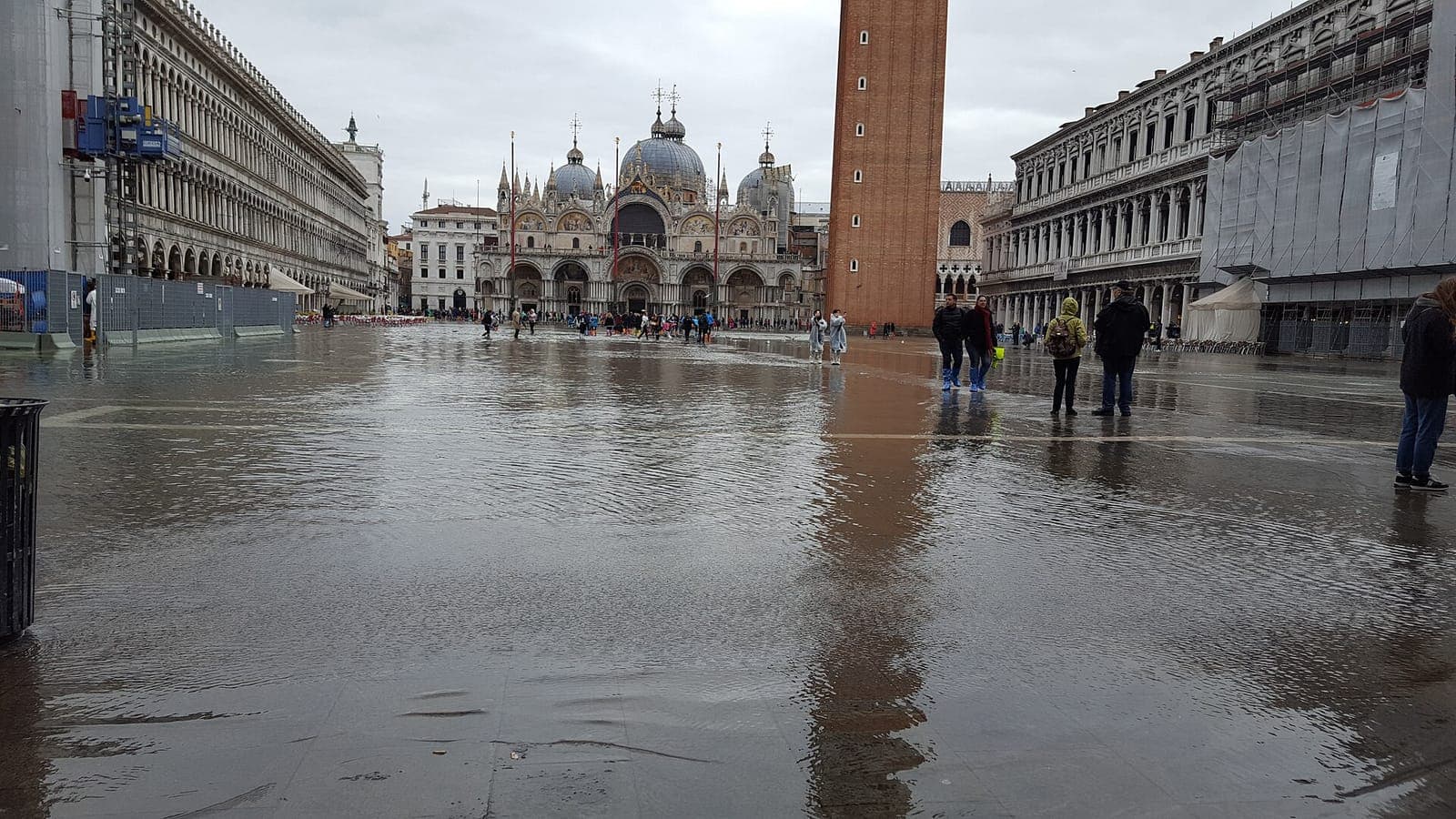
Venice has always lived with the tide. Twice a day the Adriatic pushes into the lagoon and drains out again, and a few times each winter it climbs high enough to spill over the quaysides into the squares. Venetians call it acqua alta. In November 1966 it rose higher than anyone had ever recorded, and it changed the way the city thinks about its future.
A tide with accomplices
The ordinary tide in Venice is modest, rising and falling by well under a metre. What makes acqua alta is a set of accomplices. The most important is the sirocco, a warm, moist wind from the south-east that blows the length of the Adriatic and heaps water up against its northern end, exactly where the lagoon lies. A deep low-pressure system over the sea lifts the water further still, and the long, narrow Adriatic can slosh back and forth like water in a bathtub, adding a rhythm of its own.
When these arrive together with a spring tide around a new or full moon, the water can rise well over a metre above the reference level, defined by the mean sea level of 1897 at the Punta della Salute tide gauge. Piazza San Marco, the lowest point in the city, starts to flood at roughly 80 to 90 centimetres. At 110 centimetres, the official threshold for an exceptional tide, more than a tenth of the city is under water; at 140, more than half. The season runs from October to January, when sirocco winds and Atlantic depressions are most frequent.
4 November 1966
In early November 1966 a stubborn depression parked itself over the western Mediterranean and drew a ferocious sirocco up the Adriatic for days, while torrential rain fell across northern and central Italy. On 4 November the tide at Venice failed to go out. Pushed by the wind, the water rose through the day and reached 194 centimetres above the datum, a level never recorded before or since. For roughly a full day the whole city stood in the sea, and the same storm system sent the Arno through Florence in the flood that ruined its libraries and churches.
In Venice the damage was less visible than in Florence but just as serious. Ground-floor homes, shops and workshops were wrecked, heating oil from ruptured tanks spread across the water and soaked into brickwork, and the sea walls of Pellestrina were breached by the sea. The flood convinced Italy and international organisations that the city could not simply be left to the tide. It led to a Special Law for Venice in 1973 and, decades later, to the engineering that now guards the lagoon.
Why the water keeps rising
Acqua alta is older than the record books, but it has become much more frequent. Part of the reason is that Venice has sunk. Through the middle of the twentieth century, industry at Porto Marghera pumped groundwater from beneath the lagoon, and the city settled by several centimetres before the wells were closed in the 1970s. Add the slow natural compaction of the lagoon sediments and the global rise in sea level, and Venice today sits roughly a quarter of a metre lower relative to the sea than it did in 1897.
The consequences show in the statistics. In the early twentieth century a tide above 110 centimetres was a rare event, arriving a handful of times in a decade. In recent decades it has happened many times a year, and the worst events have clustered: on 12 November 2019 the water reached 187 centimetres, the second-highest on record, and that same autumn brought several more exceptional tides within a few weeks. Each one soaks the brick and stone of buildings that were designed to stand above the water, not in it.
Sirens, walkways and the MOSE
Venetians have developed a routine. Forecasts come from the city's tide centre, and when a high tide is expected sirens sound across the city, with a rising sequence of tones that tells listeners how high the water will go. Municipal workers set out raised walkways, the passerelle, along the main routes, shopkeepers slot metal barriers into their doorways, and everyone pulls on rubber boots. For a tide of 100 or 110 centimetres, life carries on with only a little inconvenience.
For the big ones there is now the MOSE, a system of 78 mobile steel gates lying on the seabed at the three inlets that connect the lagoon to the Adriatic: Lido, Malamocco and Chioggia. When a dangerous tide is forecast, compressed air empties the gates of water and they swing up to close the lagoon off from the sea. First raised in earnest in October 2020, after decades of construction and controversy, the barriers have since kept Piazza San Marco dry through tides that would once have flooded it.
Walk through Venice on a still November morning and you may find San Marco shining like a mirror, tourists in plastic boots and locals stepping calmly along the walkways. The sirens, the boots and the gates out at sea are all descendants of one night in 1966, when the city learned exactly how high the water could climb.


 New Zealand
 Türkiye