
 Norway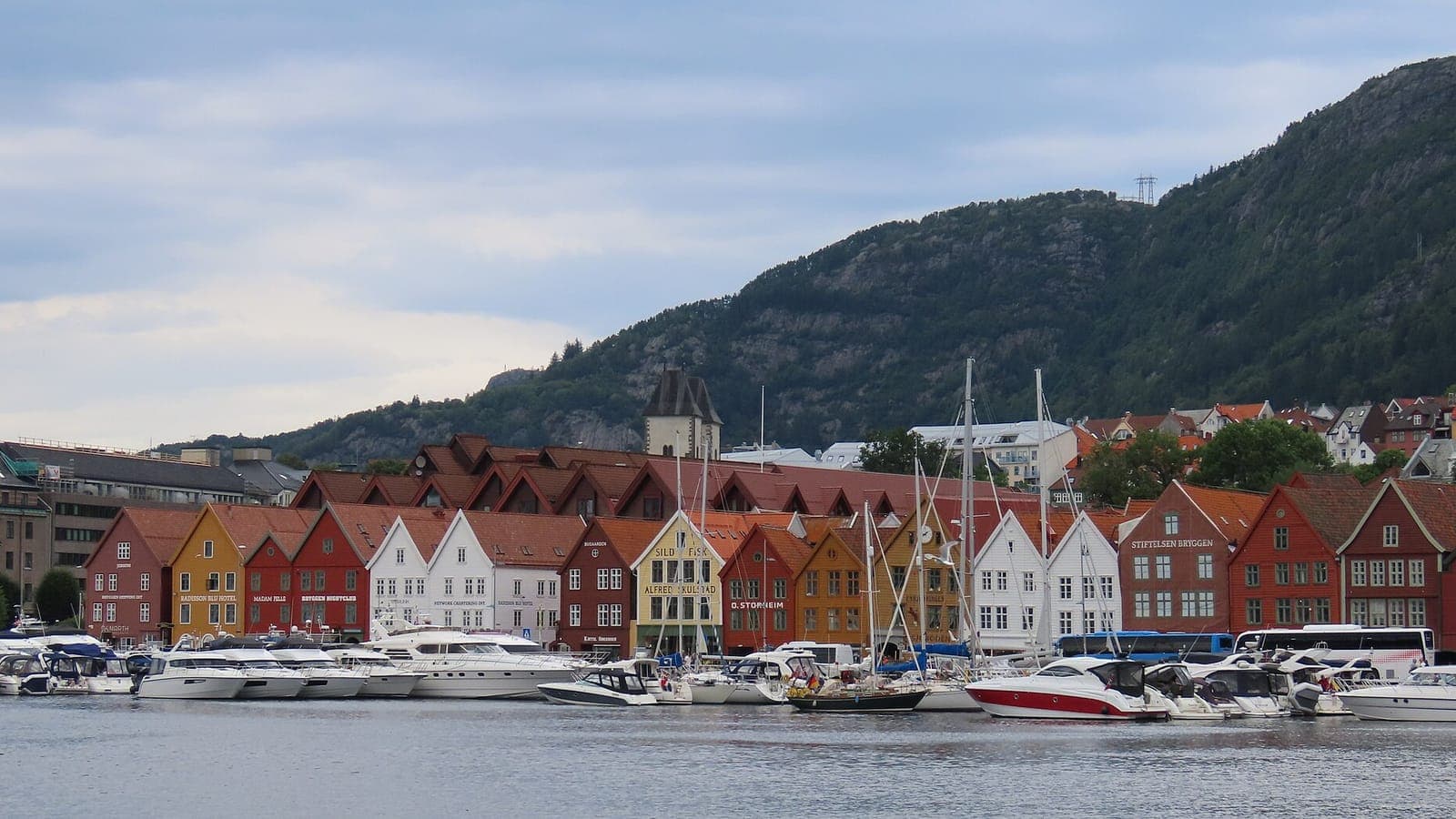
Norway shares its latitudes with Alaska and southern Greenland, yet its coast stays green and open to shipping all winter. The price for that mildness is paid in rain, and nowhere more generously than in Bergen. Both stories begin in the same place: the warm Atlantic water that flows north along the Norwegian coast.
A city between seven mountains
Bergen receives well over 2,000 millimetres of precipitation in a typical year, several times more than London or Paris, and it rains or drizzles on roughly two days out of three. The reason is geography. Moist air from the Atlantic arrives on the prevailing westerly winds and meets a wall of mountains almost at the water's edge. Forced upwards, the air cools, its vapour condenses and the clouds unload. Meteorologists call this orographic rain, and western Norway is a textbook example of it.
Bergen itself is squeezed between the sea and a ring of hills that locals call the seven mountains, among them Fløyen and Ulriken. Clouds that pile up against their slopes can sit over the city for days. Bergensers have made their peace with this. Umbrellas and waterproof jackets are everyday wear rather than emergency gear, children play outside in rain suits, and a saying heard all over Scandinavia holds that there is no bad weather, only bad clothing. A dry, sunny week feels like a small festival.
Eighty-five days in a row
Bergen's reputation is not just a joke. In the autumn and winter of 2006–07 the city recorded rain every single day for 85 consecutive days, a streak that made headlines well beyond Norway. Heavy downpours are also a genuine hazard here. The steep hillsides above the houses can become saturated, and landslides and flooding are a recurring concern after long wet spells. Local authorities and the national weather service keep a close eye on how much water the ground has already absorbed before the next front arrives.
Fittingly, the rainy city became one of the birthplaces of modern forecasting. From 1917 the physicist Vilhelm Bjerknes and a small team of young scientists in Bergen studied the weather systems that kept rolling in from the Atlantic. The Bergen School, as it became known, described how low-pressure systems form along the boundary between cold polar air and warmer air, and it gave the world the terms cold front and warm front. Every weather map with those blue and red lines still carries a little of Bergen in it.
A warm river in the sea
The rain and the mildness share a source. The Gulf Stream carries warm water from the tropics past Florida and up the east coast of North America before turning out across the Atlantic. Its northern continuation, the North Atlantic Current, flows along the whole Norwegian coast and on towards the Barents Sea. Winds blowing across this water pick up both heat and moisture, which is why western Norway is at once far wetter and far milder than other places at the same latitude.
The practical result is striking. Harbours along the Norwegian coast stay free of ice through the winter, even far above the Arctic Circle in towns such as Hammerfest. Narvik ships iron ore from the mines of northern Sweden all year precisely because its fjord does not freeze, while ports in the northern Baltic, much further south, can be locked in ice. The coastal ships of the Hurtigruten have sailed up and down this coast through every winter for more than a century, a route that would be unthinkable without warm water.
Two Norways
Cross the mountains and the weather changes character. Oslo and the east lie in the rain shadow of the high plateaus, so they receive far less precipitation and have colder, more continental winters, with snow that stays on the ground and a fjord that can freeze in hard years. Inland in the far north the contrast is even sharper: Karasjok in Finnmark holds Norway's lowest recorded temperature, minus 51.4 °C, measured on New Year's Day 1886. The coast of the same county is dramatically milder.
Out in the ocean, the Lofoten Islands show the warm current at its most generous. Although they lie well north of the Arctic Circle, their winters are so mild that average temperatures hover not far from freezing, one of the largest warm anomalies for any place at that latitude. That cool, windy, rarely frozen air is exactly what the islands' famous stockfish needs. Cod caught in the winter fishery is hung on wooden racks to dry in the open air until spring, a tradition kept alive for many centuries.
Visitors to Bergen soon learn to pack a raincoat whatever the forecast says, and to savour the moment the clouds lift off Fløyen. Further north they notice something stranger: open water and fishing boats at work in the middle of an Arctic winter. Both are the Atlantic's signature. Scientists follow the ocean currents closely today, because Norway's mild coast depends on warm water continuing to find its way north.

 Thailand
 Austria