
 Indonesia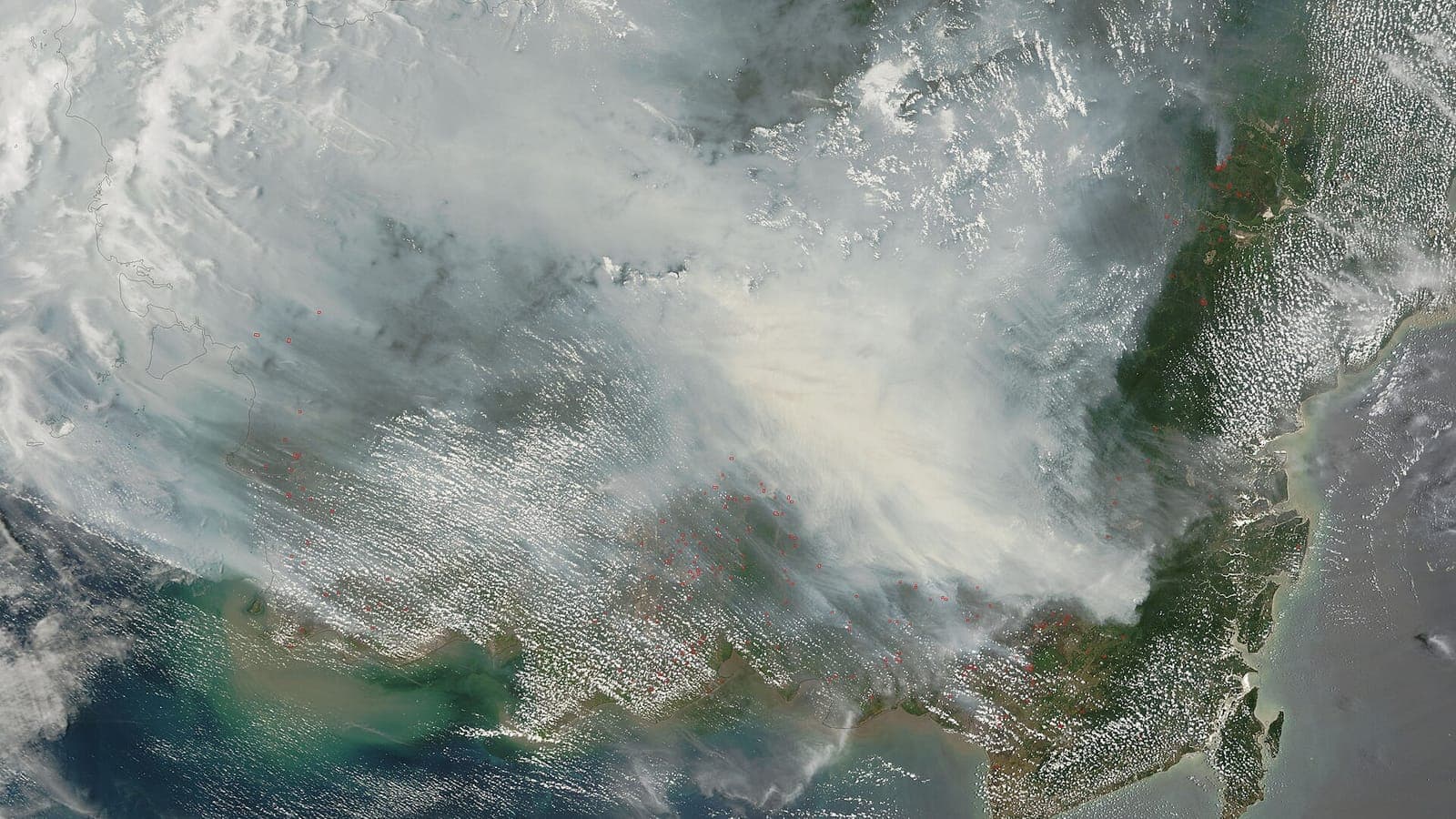
Indonesia stretches across more than 17,000 islands on both sides of the equator, and its year is ruled not by temperature but by rain. The monsoon brings it and the monsoon takes it away. When El Niño delays the return of the rain, the consequences can reach far beyond the country's borders, as the whole region learned in 1997.
A year measured in rain
In Jakarta the thermometer barely moves: most days reach the low thirties Celsius, whatever the month. What changes is the sky. Indonesians speak of two seasons, musim hujan, the rainy season, and musim kemarau, the dry season. Across much of the country the rains arrive around November and last until March or April, while the drier months run roughly from May to September. The shift is rarely gentle. Within a few weeks, dusty afternoons give way to towering clouds and cloudbursts that flood streets in minutes.
Behind this rhythm lies the monsoon, a seasonal reversal of the winds. During the northern winter, air flows out of cold continental Asia, crosses the equator and bends into a westerly wind that has soaked up moisture over the South China Sea and the Indian Ocean. Half a year later the pattern flips: in the southern winter, dry air blows from Australia towards the northwest. Indonesians often call these the west monsoon and the east monsoon, and the farming calendar, from planting rice to harvesting it, follows them closely.
One country, many rainfall patterns
Indonesia is so large that the textbook pattern bends from island to island. Close to the equator, in much of Sumatra and Kalimantan, there is hardly a real dry season at all; rain falls throughout the year, often with two peaks. Further south and east, in Java, Bali and especially Nusa Tenggara, the contrast is sharp, and islands such as Sumba and Timor turn brown and parched long before the rains return. Their dry savannas look closer to northern Australia than to the rainforests of Borneo.
Then there are the exceptions. In parts of Maluku, including Ambon, the calendar runs almost the other way round, with the heaviest rain falling around June and July, just as most of the country is drying out. And some places simply collect storms. Bogor, south of Jakarta, is nicknamed Kota Hujan, the City of Rain, because thunderstorms build over the surrounding volcanoes on a great many afternoons of the year. For travellers, this means there is almost always somewhere in Indonesia where it is dry.
1997: the year the rain stayed away
The monsoon's weak point is the moment it turns. In an El Niño year, warm water in the Pacific shifts east, and the rising air that normally feeds Indonesia's storms moves with it. The dry season lasts longer and the rains start late. In 1997, during one of the strongest El Niño events of the twentieth century, that is exactly what happened. Across Sumatra and Kalimantan the dry season dragged on well beyond its usual end, and forests and fields became unusually dry.
Fire was already a common tool for clearing land for oil palm, pulpwood and farms, and in 1997 it ran out of control. The worst damage happened on peatland, thick layers of waterlogged plant matter that had been drained by canals, among them the Mega Rice Project in Central Kalimantan, which cut through around a million hectares of peat swamp. Dried peat burns slowly and underground, can smoulder for weeks and is almost impossible to put out. Millions of hectares burned, and in the end only the returning rains could stop it.
The haze that crossed borders
The smoke became a regional disaster. Through September and October 1997 a thick, yellowish haze lay over large parts of Sumatra and Borneo and drifted to Singapore, Malaysia and Brunei, with traces reaching southern Thailand and the Philippines. Schools and airports closed, and the Malaysian state of Sarawak declared a state of emergency. On 26 September, Garuda Indonesia Flight 152 crashed on its approach to Medan in poor visibility caused by the haze, killing all 234 people on board.
Scientists later calculated that the burning peat had released an enormous amount of carbon; one widely cited estimate in the journal Nature put it at roughly 13 to 40 percent of that year's global emissions from fossil fuels. The crisis led the ASEAN countries to sign an agreement on transboundary haze pollution in 2002, which Indonesia ratified in 2014. Yet the pattern returned in later droughts, most severely in 2015, another strong El Niño year, a reminder of how closely Indonesia's air is tied to the timing of its rain.
Today the rhythm is easy to feel. Visit Java or Bali in January and you plan your day around the afternoon downpour; come in July and the skies are mostly clear and the rice fields dry out. In years when El Niño is forecast, Indonesians and their neighbours watch the air-quality index between August and October, knowing that a late monsoon can once again mean smoky skies over Sumatra, Borneo and Singapore.

 Morocco
 Romania