
 Singapore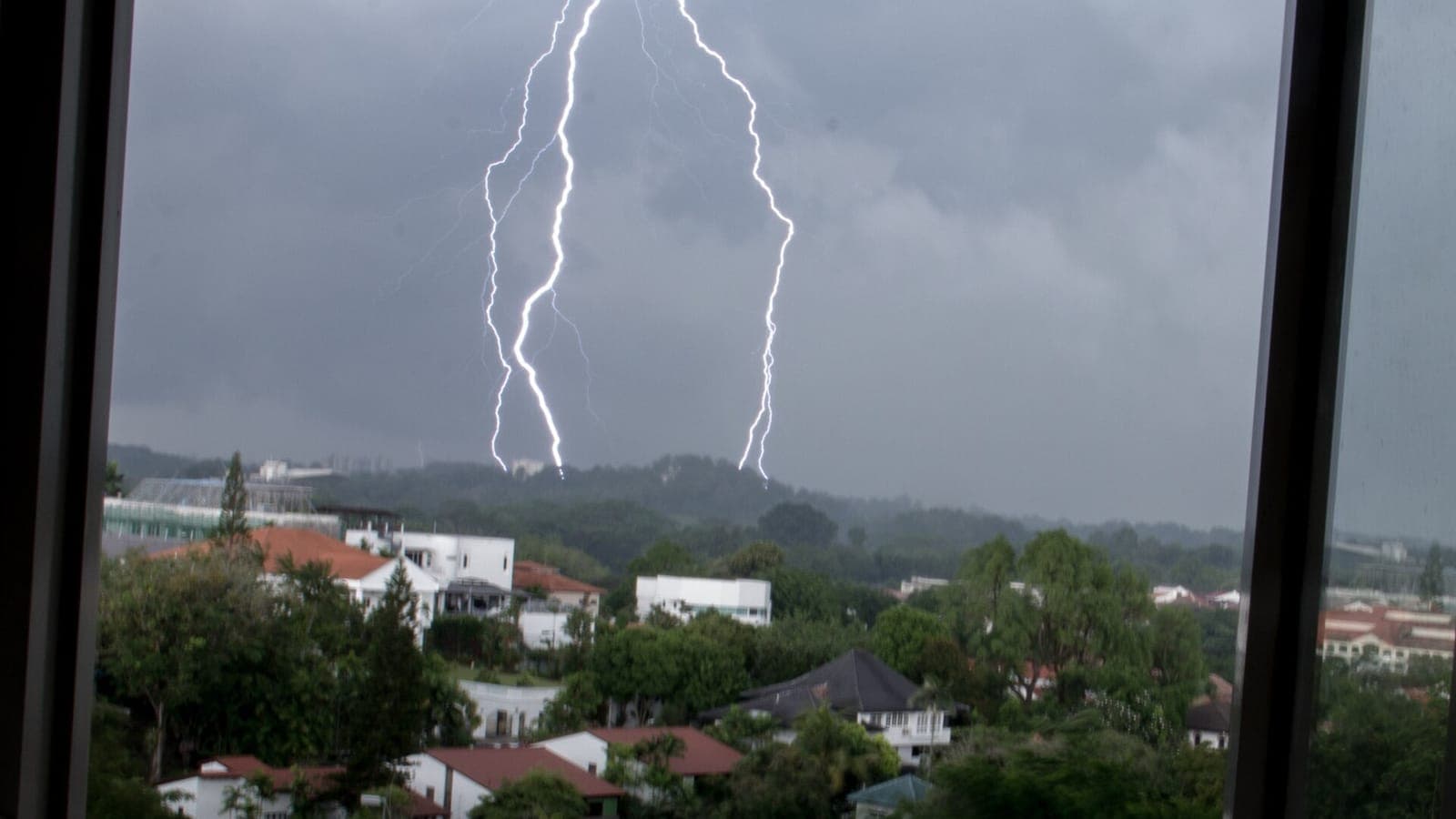
Singapore has no winter and no summer, but it does have a weather rhythm all its own. Between roughly April and November, lines of thunderstorms born over Sumatra march across the Strait of Malacca at night and hit the island around dawn. Locals call them Sumatra squalls, and they are one of the most distinctive features of equatorial weather.
A storm with an alarm clock
A Sumatra squall usually announces itself in the small hours. The air is still and warm, then the wind suddenly picks up, often gusting at 40 to 80 km/h. Trees bend, loose objects fly across balconies and the temperature drops by several degrees within minutes. Heavy rain follows, frequently with thunder and lightning, and it can pour for an hour or two before easing off into a grey, drizzly morning.
Because the squalls so often arrive between midnight and the early morning, many residents meet them as a wall of noise against the windows or a soaked walk to the bus stop. For ships and small boats in the busy Singapore Strait they are a real hazard: the gusts come without much warning, the sea turns choppy within minutes, and visibility can collapse in the heavy rain. Mariners and port operators watch for them closely.
Born over Sumatra at night
The squalls begin on the other side of the Strait of Malacca. During the night, the land of Sumatra cools faster than the sea, and a cool breeze flows off the island toward the water. Over the strait this land breeze meets the moist southwesterly winds of the monsoon season. Where the two air streams collide, the warm, humid air is forced upward, and towering thunderclouds grow in the dark.
Instead of remaining scattered showers, the storms often organise into a squall line, a narrow band of thunderstorms that can stretch for hundreds of kilometres. Steered by the winds higher up, the line moves east toward the Malay Peninsula and Singapore. Its timing is the key to its character: a line that forms over Sumatra in the evening or around midnight typically reaches Singapore in the hours before and around sunrise.
A city with no seasons, only monsoons
Sumatra squalls fit into a wider pattern. Singapore lies just north of the equator, so temperatures barely change through the year, typically from the mid-20s at night to the low 30s in the afternoon. What changes is the wind. The northeast monsoon blows roughly from December to early March, the southwest monsoon roughly from June to September, and the inter-monsoon periods in between bring light winds and frequent afternoon thunderstorms.
Rain falls in every month, adding up to well over 2,000 millimetres a year, and Singapore has one of the highest rates of lightning activity in the world. That is why the island is laced with deep concrete drains and canals. Marina Barrage, completed in 2008, turned the mouth of the Marina Channel into a freshwater reservoir and helps protect low-lying parts of the city centre from flooding when heavy downpours coincide with high tide.
Watching the strait
Forecasters at the Meteorological Service Singapore track the squalls on weather radar and satellite images as they build over the strait during the night. Because a squall line moves fairly steadily, it is often possible to give a few hours' warning of strong winds and heavy rain. The service publishes forecasts and alerts on its website and mobile apps, and many early risers check the rain radar before heading out.
The same southwesterly winds that feed the squalls have a darker side. In some dry years, smoke from land and forest fires in Sumatra is carried across the strait, and Singapore disappears into a brown haze, as it did in 2013 and 2015. On those days residents watch the wind direction as closely as the rain, and a heavy downpour that washes the air clean is greeted with real relief.
Spend a few weeks in Singapore between April and November and you will probably meet a Sumatra squall yourself: a sudden gust rattling the windows before dawn, a hard, noisy downpour, and then a cooler, freshly washed morning. By breakfast the drains are roaring, the streets are steaming and the sun is often back out, as if nothing had happened.

 Argentina
 China
China