
 Sweden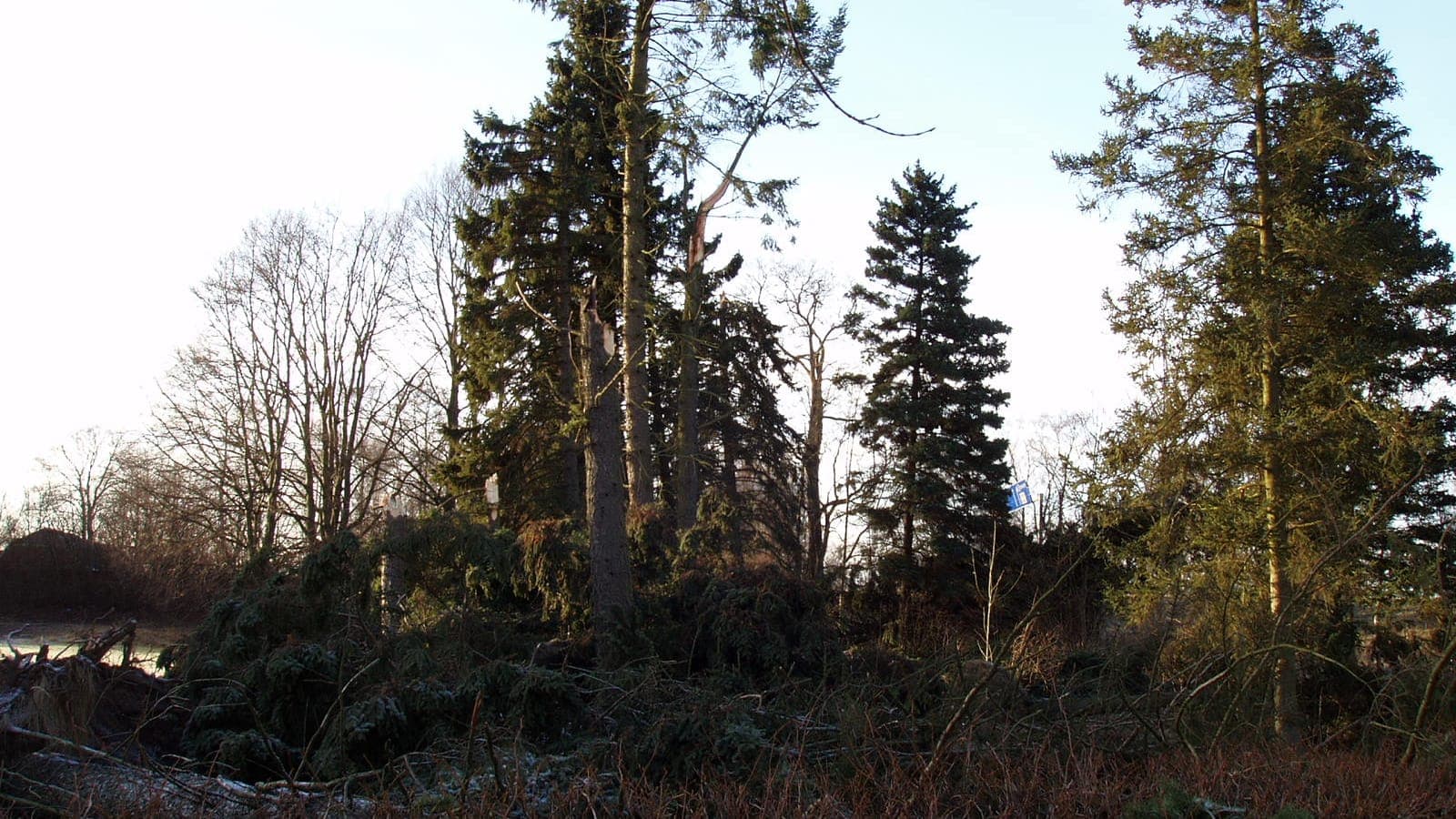
Sweden is a forest country: roughly seven tenths of its land is covered by trees, most of them spruce and pine. On the evening of 8 January 2005 a storm named Gudrun swept in from the North Sea and, within hours, turned the forests of southern Sweden into a tangle of fallen timber. It remains the most destructive storm in modern Swedish history.
A deep low with a long fetch
Gudrun was an ordinary Atlantic winter low that became extraordinary. It deepened rapidly as it crossed the North Sea on 8 January 2005 and tracked north-eastwards over Norway and central Sweden. That put the whole of southern Sweden, the region called Götaland, on the storm's dangerous southern side, where the winds are strongest. From the late afternoon a south-westerly gale built across Denmark and the Swedish west coast, then pushed inland over Halland, Småland and Blekinge during the evening and night.
Hurricane-force gusts were recorded along the coast: at Hanö, off Blekinge, gusts reached around 42 metres per second, and the mean wind at exposed stations was of a strength Sweden's Baltic coast rarely sees. What made Gudrun unusual was not only its speed but its reach. Far from the sea, in the rolling inland forests of Kronoberg and Jönköping counties, the wind was still strong enough to lay down whole hillsides of trees.
Why the trees could not hold
The Swedish spruce, Norway spruce, is a shallow-rooted tree. On the moraine soils of Småland its roots spread wide but not deep, and it stands best when it stands together, in a closed stand where every tree shelters its neighbour. Much of southern Sweden's forest had been planted in the decades after the war as dense, even-aged spruce plantations, often on former farmland with thin soil. Such stands are efficient, but they behave like a single sail in a storm.
Then came the weather before the weather. The autumn and early winter of 2004 had been mild and wet, and in January 2005 the ground in Småland was not frozen. Frozen soil holds roots like concrete; saturated, unfrozen soil lets them out like a loosened tooth. When Gudrun's gusts arrived from the south-west, the trees simply tipped over, taking their root plates with them, and once the edge of a stand gave way the wind rolled through it row by row.
Timber mountains and dark villages
By morning, an estimated 75 million cubic metres of forest lay on the ground, roughly what the whole of Sweden harvests in a normal year, concentrated in a handful of southern counties. Roads and railways were blocked by trunks, and around 415,000 households lost electricity because falling trees took down the overhead lines that ran through the forest. In the worst-hit areas some homes were without power for weeks, in the middle of a Nordic winter, and telephone networks failed along with them.
Seven people died in Sweden during the storm itself, and more lost their lives in the months of dangerous clearing work that followed, when tensioned trunks and root plates could spring back without warning. The fallen timber had to be salvaged before insects and fungi ruined it. At Byholma, near Ljungby, a former airfield became one of the largest timber stores in the world, where about a million cubic metres of logs were stacked in enormous piles and sprayed continuously with water to keep them fresh.
What Gudrun changed
Gudrun rewrote the rules for Swedish infrastructure. Power companies committed to burying cables or moving lines out of the forest and onto cleared corridors, so that the next big storm would not repeat the weeks of darkness. When Storm Per struck the same region in January 2007 and felled around 12 million cubic metres of trees, the power cuts were shorter and the response faster. The lessons were expensive, but they were learned.
The forest itself is changing more slowly. Many owners who replanted after 2005 chose to mix in birch and other broadleaves, to thin more carefully and to leave sheltered edges, accepting a little less yield for a lot more resilience. The storm also left a mark on language: Gudrun became the name every Swede associates with wind, and the Swedish weather service later began naming severe storms itself, so that warnings would carry the same weight the next time.
Drive through Småland today and you can still read Gudrun in the landscape: wide areas of young, even-aged forest planted after 2005, more birch among the spruce, and power lines running along roads instead of vanishing into the trees. When a January gale rattles the windows, Swedes still ask each other the same question: is this going to be another Gudrun?

 United Arab Emirates
 Switzerland