
 Switzerland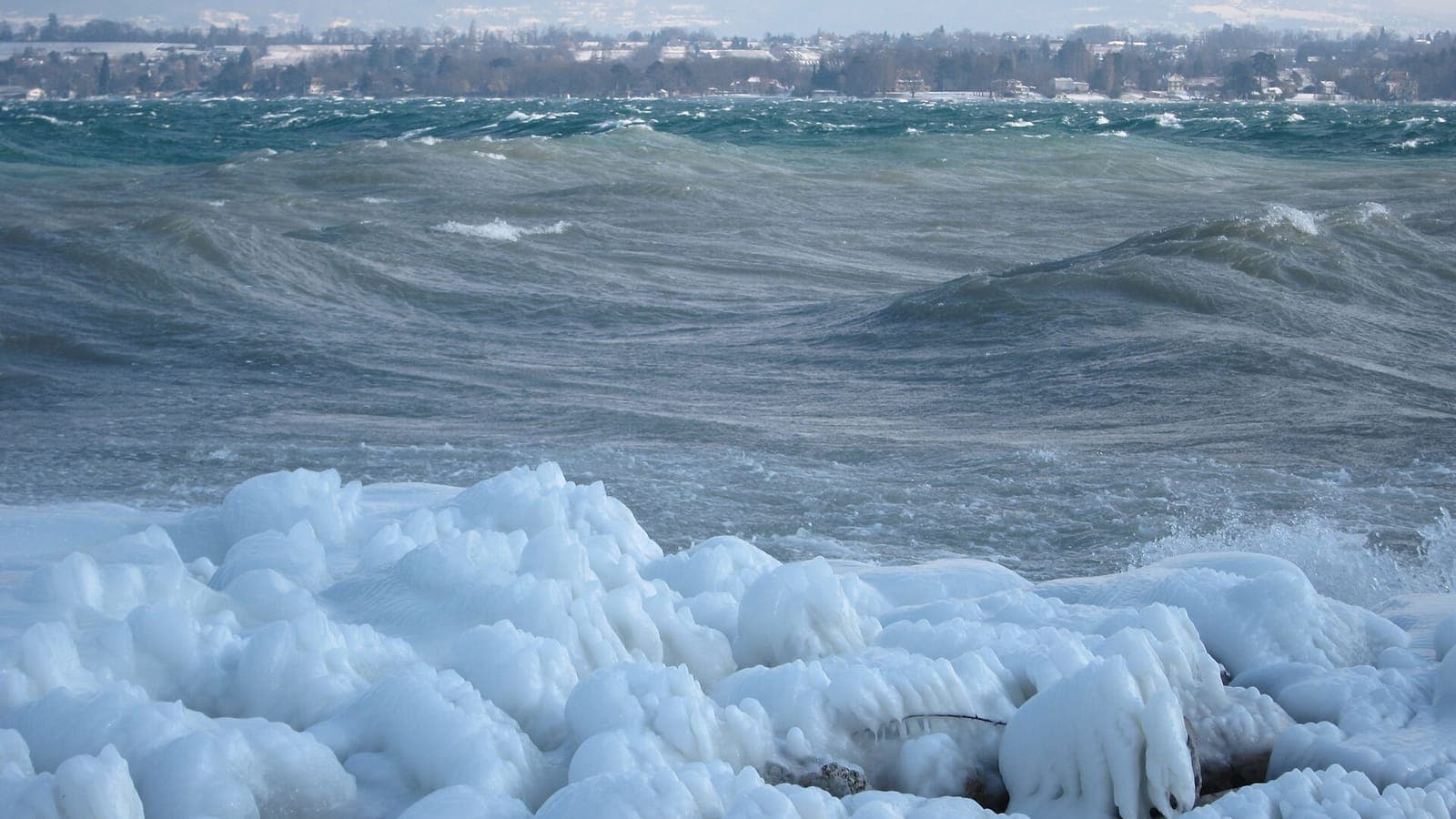
Most visitors know the föhn, the warm wind that pours down Alpine valleys. Switzerland's other great wind is its cold opposite: the Bise, a dry north-easterly that funnels across the country's lowlands. Every few years it shows its full strength, and in 2012 it froze the shores of Lake Geneva solid.
A wind squeezed between two mountain ranges
The Bise is a cold, dry wind from the north-east that blows across the Swiss Plateau, the broad lowland where most Swiss people live. It usually appears when high pressure sits over northern Europe and lower pressure lies further south. Air then flows from the north-east towards the south-west, and in Switzerland it has little choice about where to go: the Jura mountains stand on one side, the Alps on the other.
Between these two walls the Plateau works like a funnel that narrows towards the south-west. As the channel tightens, the wind speeds up, so the Bise is often at its strongest at the far end of the funnel, around Lake Geneva. Zurich may feel a brisk breeze while Geneva is battered by gusts. The same geometry explains why the Bise can keep blowing for days on end once the pressure pattern has settled in.
Black Bise, clear Bise
Swiss forecasters and locals distinguish two moods of the wind. The clear Bise, bise claire in French-speaking Switzerland, comes with a cloudless, deep-blue sky and remarkable visibility: from the shores of Lake Geneva the Alps look close enough to touch. The black Bise, bise noire, arrives under a thick grey lid of low cloud, and it can feel grim and raw for days, especially in winter when the sun barely breaks through.
That low cloud is closely related to one of the Plateau's winter trademarks, the sea of fog, known in German as Nebelmeer. Cold air gets trapped beneath a warmer layer, and a flat grey ceiling can cover the lowlands for a week or more while the mountain tops bask in sunshine above. Many Swiss simply take a train or cable car uphill to escape it. In summer, by contrast, a gentle Bise often brings dry, fresh and pleasantly clear days.
February 2012: Geneva under ice
In late January and early February 2012 a severe cold wave spread across much of Europe from the east. In Switzerland it brought days of freezing temperatures together with a strong, persistent Bise. On Lake Geneva the wind whipped up waves that crashed against the quays of Geneva and of lakeside towns such as Versoix. Every burst of spray froze almost as soon as it landed, and the next wave added another layer.
Bit by bit the ice built up into thick, glassy crusts. Railings, benches, lamp posts, trees and boats were coated, and cars parked along the lakefront vanished under shells of ice so heavy that their owners could not open the doors. Long icicles hung sideways in strange shapes, sculpted by the wind. The pictures travelled far beyond Switzerland, and crowds of Genevans braved the cold to photograph a lakefront that looked as if it belonged in the Arctic.
Switzerland's two winds
The Bise and the föhn are often called Switzerland's two signature winds, and they could hardly be more different. The föhn comes from the south, dropping down the northern Alpine valleys as a warm, dry fall wind. The Bise comes from the north-east across the open lowlands, and in winter it makes the air feel much colder than the thermometer suggests. Both show how strongly the country's weather is shaped by its mountains.
Living with the Bise is simply part of life around Lake Geneva. Sailors know it as a demanding but dependable wind, and the city's famous Jet d'Eau fountain is switched off when strong wind or frost make it unsafe to run. An old local saying claims the Bise lasts three, six or nine days. Meteorologists would not put it quite so neatly, but the saying captures something real: once it starts, the Bise tends to stay.
Stand on a Geneva quay on a clear winter day when the Bise is blowing and you feel it at once: a hard, dry wind that cuts through a coat and drives whitecaps across the lake. Flags stand out stiffly and the Alps gleam on the horizon. Watch the weather maps too: when high pressure settles over northern Europe, the Swiss know the Bise is on its way.

 Finland
 Ireland