
 United Arab Emirates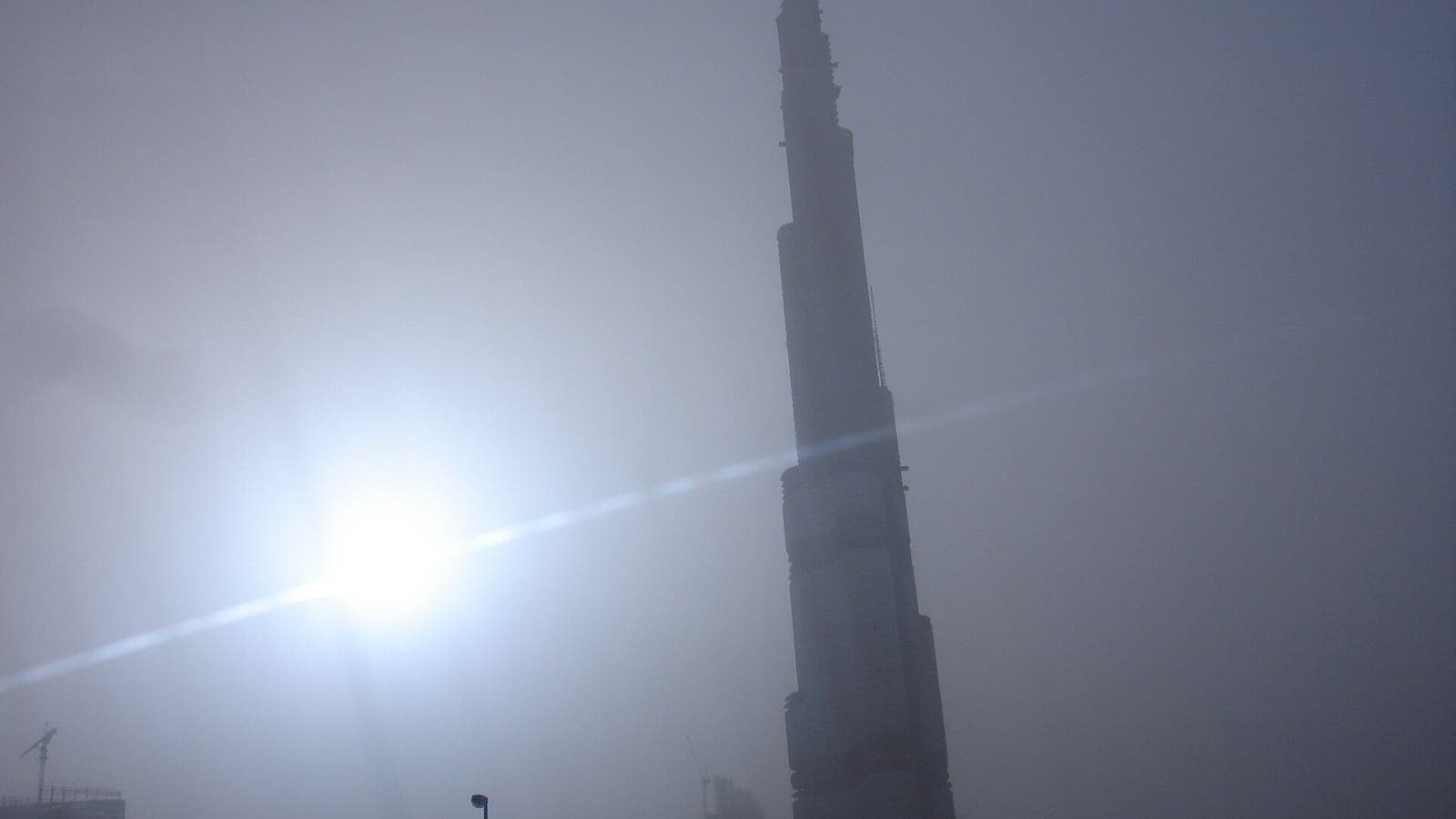
Ask anyone who has spent a July in Abu Dhabi or Dubai what the weather was like, and the answer is rarely just 'hot'. It is the dust that arrives on a stiff north-westerly, the haze that swallows the skyline, and then the damp, heavy air that fogs sunglasses the moment you step outside. Two very different forces shape the Gulf summer, and they take turns.
The wind called north
Shamal simply means 'north' in Arabic, and the name describes the wind's direction rather than its character. It is a north-westerly that pours down the valley of the Tigris and Euphrates, across the deserts of Iraq and Kuwait, and out over the Persian Gulf. On one side rise the Zagros Mountains of Iran; on the other lies the high ground of the Arabian Peninsula. Between them the air is funnelled and accelerated, much as a river speeds up where its banks narrow, so that by the time it reaches the Emirates it can carry the desert with it.
What it carries is dust. The floodplains of Mesopotamia and the dry beds of southern Iraq are among the most productive dust sources on Earth, and a strong shamal lifts that fine material thousands of metres into the air. Visibility in Dubai can fall to a few hundred metres, flights are delayed, and the sun becomes a pale disc behind an orange veil. Ships in the Gulf have feared the shamal for centuries; the old pearling dhows would run for shelter when the sky to the north turned the colour of copper.
Winter fronts and the forty-day wind
There are really two shamals. The winter version is short and violent, arriving behind cold fronts that sweep across the Middle East between November and March. It is often preceded by a warm, humid south-easterly known locally as the kaus, which gives the front a day or two of warning. Then the wind swings round to the north-west, the temperature drops sharply, and for one to five days the Gulf is whipped into steep, short waves that make small craft miserable.
The summer shamal is different in nature. From late May or early June it can blow almost without pause for weeks, which is why sailors and fishermen along the coast have long spoken of the 'forty-day shamal'. It is driven by the vast pressure difference between the monsoon low over Pakistan and the high pressure over the eastern Mediterranean. Rather than bringing cool air, it brings relentless heat and haze, and it blew through the heart of the old pearl-diving season, when crews spent months at sea.
A shallow sea that steams
When the shamal eases, the other face of the Gulf summer appears. The Persian Gulf is remarkably shallow, with an average depth of only a few tens of metres, and in summer its surface warms to well above 30 °C, warmer than most swimming pools. Water that warm evaporates furiously. Each afternoon a sea breeze pushes the moist air inland, and along the coast the dew point can climb into the thirties, a level that few other inhabited places on Earth ever reach.
The result is air that feels thick enough to lean on. Relative humidity on a summer night near the coast can approach 100 percent, and glass doors, cameras and spectacles fog instantly when you leave an air-conditioned building. Scientists use the wet-bulb temperature, which combines heat and humidity, to describe such conditions, and the shores of the Gulf are among the few places where readings have come close to the limit at which a healthy human body can no longer cool itself by sweating.
Living with wind and water
Long before air conditioning, the people of the coast built with the wind. In Dubai's Al Fahidi district, houses raised by merchants around the turn of the twentieth century carry tall wind towers, called barjeel, open on four sides. They catch any breeze, however slight, and channel it down into the rooms below, where it passes over damp cloth or water jars and cools. Narrow, shaded alleys known as sikkas kept the sun off the walls, and families slept on the roof when the humidity made indoor nights unbearable.
Today the response is mechanical: the Emirates run some of the most powerful cooling systems anywhere, and summer life moves indoors from late morning until evening. Yet the same warm, moist sea that torments July delivers a gift in winter. On still December and January mornings the humid air cools overnight and condenses into dense fog, and photographs of Dubai's towers rising above a white sea of cloud have become almost as famous as the towers themselves.
Visitors who step out of the airport in August feel both forces within seconds: a warm gust that smells faintly of dust, and air so moist it seems to cling. Residents read the sky the way sailors once did. A copper haze to the north means the shamal is coming; a hazy, glassy horizon over the sea means a humid night ahead. In winter, the same sky may give you a morning wrapped in fog.

 Switzerland
 Finland