
 United States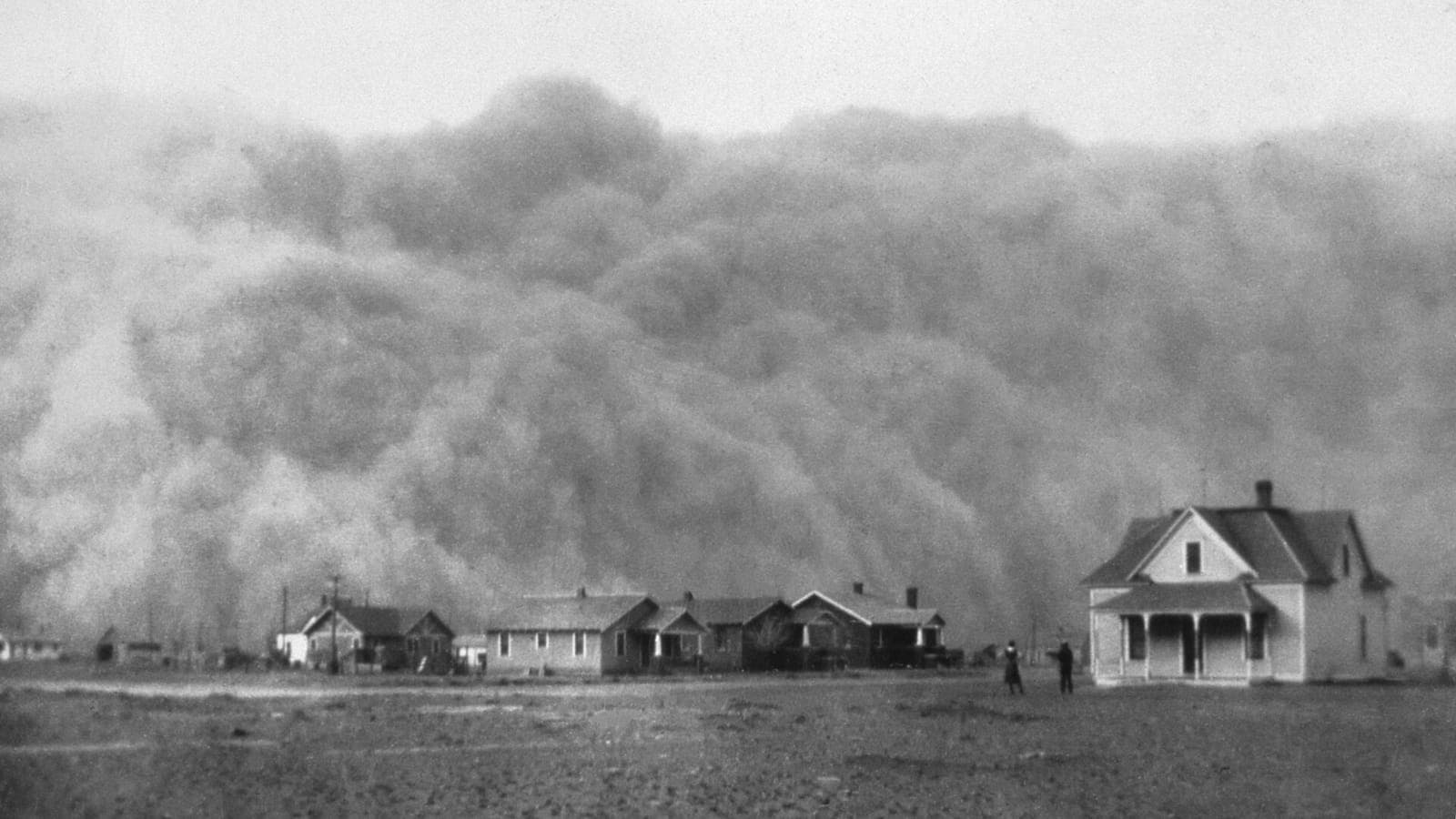
For most of the 1930s, the southern Great Plains of the United States were the scene of a slow-motion catastrophe. Drought met a land stripped of its native grass, and the wind did the rest. Storms of black dust turned noon into midnight, buried fences and killed cattle, and drove hundreds of thousands of people off their farms. Americans called the region the Dust Bowl, and the name stuck.
The great plow-up
The southern plains were never meant to be ploughed. Short buffalo grass, with roots that went deep and knitted the soil together, had held the ground through centuries of drought and wind. But the Homestead Acts, cheap land and the coming of the tractor changed the calculation. When wheat prices soared during the First World War, farmers and speculators tore up millions of acres of grassland across the Oklahoma and Texas panhandles, western Kansas, eastern Colorado and northeastern New Mexico. Rain fell generously through the 1920s, and for a while the gamble paid handsomely.
The rains stopped in the early 1930s, just as wheat prices collapsed with the Depression. Fields that had been left bare after harvest, or abandoned altogether when the crop failed, had nothing to hold them down. The plains wind, which blows hard and often, began lifting the topsoil in sheets. Farmers first noticed dust drifting like snow against fence lines. Then came the storms: rolling walls of dirt, sometimes thousands of feet high, that turned the horizon brown and the sky black.
Black Sunday
The worst of the dusters came on 14 April 1935, a clear, warm Sunday morning across the plains. People went to church, hung out laundry, drove out to visit neighbours. In the afternoon a cold front swept south out of the Dakotas, and ahead of it rolled a wall of dust so dense that daylight vanished in seconds. Birds fled ahead of it; cars stalled as static electricity shorted their ignition; drivers could not see their own bonnets. Families sheltered behind wet sheets hung over windows and doors while the house filled with grit anyway.
The next day an Associated Press reporter, Robert Geiger, filed a dispatch from Guymon, Oklahoma, describing life in the dust bowl of the continent. The phrase was picked up by newspapers and became the name of the whole disaster. Black Sunday was only the most famous storm. Throughout the decade, dusters came dozens of times a year, and the fine particles worked into lungs, food and bedding. Children and the elderly died of what doctors called dust pneumonia, and the Red Cross opened emergency hospitals in the worst-hit counties.
Dust over Washington
The storms did not stay on the plains. In May 1934 a vast cloud of topsoil rode the westerlies eastwards for two days, dimming the sun over Chicago, dusting the streets of New York and Washington and sifting down on the decks of ships hundreds of miles out in the Atlantic. Easterners who had read about the drought as a distant farm problem now found it on their windowsills. It was, in effect, the plains delivering their own petition to the capital.
One man made the most of it. Hugh Hammond Bennett, a soil scientist who had spent years warning that American farming was destroying its own foundation, was testifying before Congress in the spring of 1935 as dust from the plains dimmed the light outside. The Soil Conservation Service was created that year with Bennett at its head. Federal agents taught farmers contour ploughing, strip cropping and the value of leaving stubble in the field, and the Prairie States Forestry Project began planting long shelterbelts of trees from the Dakotas to Texas to slow the wind.
The road west
Conservation could not bring back the rain, and for many families it came too late. Through the 1930s hundreds of thousands of people left the southern plains, many of them for California. Their belongings roped to old cars, they travelled Route 66 west and became known, not kindly, as Okies, wherever they actually came from. They found work in the fruit and cotton fields of the Central Valley, low wages and a cool welcome. John Steinbeck told their story in The Grapes of Wrath in 1939, Dorothea Lange photographed them, and Woody Guthrie sang about them in his Dust Bowl Ballads.
The drought finally broke at the end of the decade, when the rains returned and the Second World War lifted crop prices again. Some of the lessons held. Conservation districts, shelterbelts and, later, irrigation from the Ogallala Aquifer changed the way the plains were farmed, and when a drought of similar severity returned in the 1950s the dust, though it flew, never reached the scale of the thirties. But the grass that once held the soil is still mostly gone, the aquifer is falling, and every dry year the same question hangs over the panhandles: how much wind can the land take?
Drive across the Oklahoma Panhandle today and the Dust Bowl is written on the landscape: rows of elms and cedars planted as windbreaks, fields ploughed along the contour, green irrigation circles seen from the air. The wind has not changed. On a dry spring afternoon a brown haze can still rise off the fields, and old-timers will glance at the sky and tell you exactly what their grandparents were afraid of.

 Belgium
 Denmark